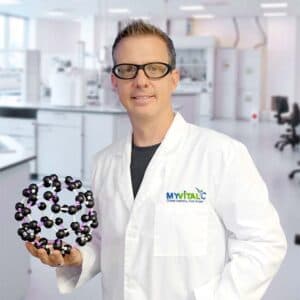
Full Transcript Introduction to Carbon 60 0:00 Mitochondria produces energy and while it's producing energy, it is producing a negative byproduct, right? 0:06 And if you're the classically trained engineer, you were like, well, we should never let it produce more energy than we can handle the negative bi-product 0:14 because we don't want aging, this is really what's driving aging and inflammation. 0:19 your body is much smarter because if you're running from a lion, you want as much energy as you can possibly get and you don't care the downstream effect 0:27 that might happen five years, 10 years whatever, 40 years from now, right? 0:31 So it's perfectly designed to be not perfect. 0:35 Welcome to Take Back My Brain with Lori Hammer, where real healing starts in the brain. 0:42 I'm Lori, a functional nutritionist and mom who's walked the path from anxiety and burnout to clarity and calm. 0:51 Each week, we're going to dive into brain-based tools like amino acid therapy, gut health, fasting and faith to help you reclaim your energy, 1:00 emotions and sense of self. 1:08 Hey, everybody. 1:08 Welcome back to Take Back My Brain. 1:10 I'm your host, Laurie Hammer. 1:11 Today, I have an exciting guest, and I cannot wait to dive into this topic because I've never talked to anybody about this Sixty you're like what is urban 1:27 sixty well we're gonna find that out today and why it's so important chris is a researcher is the founder and chief scientist of my vital see. 1:34 And he is also host of live beyond the norms and author of a live long and better so lots of stuff going on in christen's life chrys welcome to the podcast. 1:44 Laurie, thank you so much for having me. 1:45 I'm excited to jump in and be geeky. 1:48 And I am glad that Lisa introduced us. 1:49 That's really cool. 1:51 Yes. 1:51 Lisa from Pretty Well, and I know you've all heard Lisa on the podcast before, jump on over to her podcast too. 1:56 She has a great interview with Chris as well. 1:58 So let's just dive right into it. 2:00 Because this all has to do with your mitochondria and people just not feeling well, you feel blah, so many of the women listening here are like, 2:10 I just don't feel like myself. 2:11 And so we talk a lot about hormone balancing, amino acid therapy, which is my thing, but this is something totally different. 2:18 So I have never talked about this product, carbon C60 before. 2:23 Tell us what the heck is this and why is it important? 2:26 So first off, what is it? 2:28 It is this molecule. 2:30 So I'm holding up a model of the molecule, if you're listening, because this is a podcast, just imagine a soccer ball where the lines on the soccerball 2:38 represent the bonds between the carbon atoms. 2:40 You have a spherical molecule of 60 carbon items in the shape of a The molecule was discovered in 1985 at Rice University, 2:47 that's here in Houston where we're based, and the three scientists who discovered it went on to win the Nobel Prize for that discovery in 1996, a short 11 2:56 years from discovery to being awarded the noble prize. 2:59 reason they won the Nobel Prize is the molecule is amazing. 3:02 It performs as well or better than the current best material and almost every application. 3:08 So it makes better inks, better batteries, Better tires, and this is where people often get a little worried. 3:14 I go on some biohacking podcasts And this next statement may not always be true on those, but probably on this podcast, in your audience, 3:27 no one woke up this morning, looked out at their car and thought, I wonder what part of my car battery I should be consuming on a daily basis for my health. 3:34 In fact, you probably dissuade them. 3:36 If you ever wake up. 3:37 You definitely dissued that, yes. 3:38 That's not the way to take back your brain. 3:43 No chance. 3:43 And the story does actually get a little bit worse first. 3:46 One of the shapes on the exterior of this ES, we call it ESS60 and I'll talk about that in a second, but one of shapes of on exterior on this esS 60 molecule 3:54 is the same shape. 3:55 So it's not the formula but the shape as benzene. 3:59 Benzene is necessary for modern society.
How ESS-60 Was Discovered 4:01 If you have any doubts, just look around you and imagine anything that is plastic, gone, because the foundational molecule of plastics and many detergents 4:10 and medications, including aspirin, are the benzene ring. 4:13 But benzine, when it's on its own, is known to be toxic and known be carcinogenic. 4:18 So because that shape, again, not formula, but that's shape occurs 20 times on the exterior of this ESS-60 molecule, They assumed this molecule would be toxic. 4:28 This is where the story starts to get better. 4:30 Instead of being toxic, the test subjects that they gave it to, in this case, Wistar rats, lived 90% longer than the control group. 4:38 What? 4:39 90? Yes, 90. Wow. 4:43 the single longest longevity experimental results on mammals in history, peer-reviewed, published research. 4:50 Very proud to share my lab provided the material. 4:53 My lab is mentioned in that original study. 4:55 We actually, in the context of the molecule, discovered an 85 Nobel Prize in 96. Our lab started manufacturing it in 1991, a full five years before they 5:05 were awarded the Nobel prize. 5:06 So we're the oldest and longest manufacturer and distributor of a molecule on the planet, and also we are the ones that provided the material and are mentioned 5:13 in that study, that pinnacle study that changed this molecule from just being industrial applications to health and wellness. 5:21 And this is probably the right time. 5:22 C60, carbon 60, we think of as an industrial molecule for industrial application, and there is peer-reviewed published research that proves if you process 5:32 it improperly, it's harmful. 5:34 ESS 60 is C 60 that's been processed for people and pets. 5:38 Wow. 5:39 All right. 5:39 So I have to ask this. 5:41 Why are you obsessed with this molecule? 5:43 How did that happen? 5:47 Well, okay, this is a great question because obsession is not an unreasonable term, not at this point, and it starts with a 14-year-old boy who in his 5:59 room had a picture. 6:00 So a lot of people in the health and wellness space have these amazing pain to purpose, passion stories, right? 6:09 And I am a little bit envious because I don't have that. 6:12 I'm also glad because i don' have the pain, I got to skip that What drove me, so a 14 year old boy has a Lamborghini Countach on his wall, 6:22 it's candy apple red, the doors, they're going, doors are open, I could smell the leather. 6:26 I wanted one of these cars, right? 6:28 I find an article that says, if you want one these, you should become a neurosurgeon. 6:33 If you more than one, should you become an entrepreneur. 6:36 Now what 14-year-old boy wouldn't want more that one? 6:39 This is not even a debate. 6:42 So at 14, knew I was gonna be an entrepeneur. 6:45 I'm not even sure I knew what it was, whatever. 6:48 And so I know it's going to be an entrepreneur. 6:50 When it came time to go to college in my family, it understood you were going into college, but we did no prep. 6:57 I have 16 year old boy, girl twins were, and they're going in to their junior year. 7:01 We're talking about college. 7:03 That never happened in family. 7:07 I graduated from high school, hadn't applied anywhere, haven't thought about anywhere. 7:13 My dad got his, he was in the military, so he got a second civilian job in Houston. 7:18 We were in Ohio at the time. 7:19 Come down to Houston, apply at The University of Houston? 7:22 What do you study if you know you're going to be an entrepreneur? 7:25 Now I did, you mentioned my book, Live Longer and Better. 7:28 I Did some research. 7:29 This is probably that story is in that book and I was doing some. 7:32 You might think, Hey, if you're going to be an entrepreneur, then you should study entrepreneurship. 7:37 Right. 7:37 But at the time, say that again. 7:40 That would be logical. 7:41 Yeah, yeah. 7:43 I want to be an entrepreneur, study entrepreneurship. 7:45 The thing is, is when I researched for the book, at the time I was entering college, there was one entrepreneurship class, 7:54 not even a course of study in the country. 7:57 Not at The University of Houston, in The Country. 8:01 So that really wasn't on the table at all. 8:02 And I'm not even sure if I were given the same dilemma today, would I go down the path of entrepreneurship? 8:08 Because my thought process was, I am good in math, good at science, what's the fastest way to the highest salary so I could have money to invest into a business? 8:17 And for me, that was mechanical engineering. 8:20 A couple things went wrong with that plan. 8:22 One, engineering is a tough course of study. 8:24 It took me six years, not four, so it wasn't that fast. 8:27 I did get a minor in computer science and math. 8:30 And the other thing that went along is I started a company while I was still in college, and that's the company that we're talking about today. 8:36 Started manufacturing this ESS-60 molecule in 1991. In the early stages, right? 8:44 Well, here's how we ended up starting the company. 8:46 My business partner, Robert, was working at the Texas Center for Superconductivity, which is an organization housed inside the University of Houston campus. 8:55 And he was separating this material, because remember it was discovered at Rice University here in Houston, so we had early awareness or access to it. 9:04 And when you get the molecule, a powder of the molecular, it actually has multiple versions of this molecule which is 60 carbon atoms, 9:13 70 carbon, 76 carbon. 9:15 And the 60 version is superconducting. 9:17 Like I said, It's an amazing molecule. 9:20 No wonder they won the Nobel Prize. 9:21 So my business partner Robert was separating that molecule to do testing. 9:25 One day, this Professor Paul Chu incredibly famous. 9:29 You've never heard of him because he's famous in the world of superconductivity. 9:34 In fact, the building that my business partner, Robert, was working in at the time, we called it Chu's Castle because they built it because of Dr. 9:42 Paul Chu fame, right? 9:43 So the superconductor center. 9:46 Dr. 9:46 Paul Chu comes in one day and he says, hey, you guys are young kids. 9:50 This molecule is selling for $6,000 a gram. 9:54 You should go figure out how to make it and start a business. 9:57 And my business partner, Robert, is from an entrepreneurial background. 10:00 I joke that he did a back of the napkin calculation, which had only one line, $ 6, 000 a grams, and then he was off and running to build the equipment 10:09 to figure it out. 10:10 Let me get on that. 10:13 brought me in because in order to manufacture this molecule, you need to vaporize graphite in an inner environment, so no oxygen, 10:22 and at a slight vacuum, a vacuum chamber. 10:25 And it turns out that graphites is one of the hardest materials on the planet. 10:28 To vaporise, You need local temperatures of sun to vapourise graphit. 10:33 So lots of engineering challenges brought me in to help with the engineering, challenges, help for the drawings, helped with manufacturing. 10:39 And so we delivered our first quantities in 1991. Our picture of what was going to happen because this, well, one it's $6,000 a gram. 10:48 You're just going get rich that way. 10:49 How many, I guess I could do the math of how many grams do you need to sell to get to a Lamborghini? 10:53 That didn't really work out that way, but what we thought was going to happen is this molecule, the incredible value of this molecules,
From Industrial Material to Health Supplement 11:00 like in inks, batteries, tires, and photocells, was gonna lead it so that we would be on the cutting edge of the really converging industry. 11:08 It turns out it is incredibly expensive to make, as I just described. 11:13 Hard to Make and therefore expensive. 11:14 And so although it performs so well in so many applications, its price point is too high to be useful from an engineering perspective. 11:23 Science, great. 11:25 Engineering, not that great and so we knew from the beginning There were really two applications where this would just take off. 11:32 One is where if you could just put a little bit of it, cause it's so expensive and it would have an outsized impact. 11:37 I don't know. 11:38 And it turns out that's what's happening in the health and wellness space. 11:41 So we'll save that piece. 11:43 The other one is from a department of defense perspective. 11:46 Imagine if this molecule could make airplanes invisible. 11:50 It can't by the way, I'm just sure. 11:52 Don't worry. 11:52 There's no Wonder Woman planes flying around because of this. 11:55 But if it could, then it doesn't matter how much it costs. 11:58 Right. 11:59 And then it would grow and we would sell a lot of it. 12:01 Neither one of those happened. 12:03 What really happened was this study came out. 12:05 These rats live 90% longer and it's a fairly small amount, right? 12:10 So the supplement on the market is about $100 a month. 12:13 So it is not the least expensive. 12:15 It's definitely not most expensive, so it has this outsized impact on health and wellness and that's why we're in it today and what my focus is every day. 12:25 Wow. 12:26 Okay, so let's dive back into this ESS60. 12:31 What exactly is that compared to the carbon, the C60? 12:35 Yeah, excellent. 12:36 So again, see 60 industrial applications in order to, it is, if I were to wake up tomorrow and independently say, I want to make money and I wanna make 12:46 it selling supplements, no, would definitely not choose this one. 12:50 I already mentioned vaporizing graphite at the temperature of the sun, right? 12:54 So this is not fun. 12:56 The soot that comes out of that is 90% amorphous carbon garbage, 10% fullerenes, and that's the fullerens, which are the 60, 70 and 76 molecules, 13:07 right? 13:07 Different molecules. 13:08 So you have to separate that. 13:09 You have the get rid of the 90 percent junk that you just vaporized graphite for. 13:13 And then now you've got to isolate the individual molecule, carbon-60. 13:18 You do that with polar solvents. 13:19 These are unpleasant sol vents, you typically don't want to be playing with them and certainly don t want consume them. 13:24 But then you isolate it and that is your carbon 60. We further process that. 13:30 right? 13:31 So that there is little to, well, basically no non-detectable amounts of the polar solvents in order to call it ESS-60, in an order for it to be for people 13:41 and pets. 13:42 And some people are like, oh, solvency, that makes me nervous. 13:44 I understand that. 13:45 It turns out if you've ever had extracts like plant extract or These are usually developed with solvents. 13:52 The industry knows how to deal with them. 13:54 And I also like to point out those rats that were given our molecule lived 90% longer. 13:59 So I don't think we're really worried about any solvens that are in there. 14:03 That's why it's so expensive. 14:06 I think I lost your question because I went down one of my own rabbit holes. 14:10 Okay, I was just like, what makes the ESS 60? What is it? 14:14 You knew about that. 14:16 Yeah, good. 14:16 I did. 14:16 Okay. 14:17 Good. 14:18 You didn't get on a rabbit trail. 14:19 So what is this doing in the body? 14:22 I know it's targeting the mitochondria. 14:26 What does it do in in body. 14:30 So if it's okay, can I tell the story that led up to really me stepping into the role of this chief scientist of a health supplement company? 14:40 Yeah, that would be great. 14:41 Let's connect those dots. 14:43 So it's fun. 14:44 So this study comes out. 14:45 These rats live 90% longer. 14:46 That's in mid 2012. Mid 2013, we start getting phone calls from this crazy wacky group of people called biohackers. 14:54 And I can say that affectionately now because I am a bio hacker. 14:57 Yes, you are one. 14:58 It's a term of endearment now, but they are crazy and wack. 15:02 At conferences, We've got samples and we'll hand a sample to somebody at a Biohacking conference and they'll open it and start taking it, 15:09 and say, what is this? 15:12 That's a biohacker, right? 15:14 Exactly. 15:14 So they called us and they said, hey, we saw that study, how much of that stuff should I be consuming? 15:21 And my business partner, Robert and I are conservative carbon nanomaterial scientists, so we have our carbon and material scientist hat. 15:28 What we really hear him asking or them asking is that stuff that you sell to research institutions around the world to put into ink, 15:37 batteries, tires, and photocells, how much of that should I be consuming? 15:41 And our thought was zero. 15:43 We think you should consume zero, we put not for human consumption to our labeling in mid-2008. 15:48 So from 1991 all the way to mid 2013, We don't have to have not-for-human consumption on our labelling. 15:54 Now we have it on or labeling. 15:56 And I do want to make the point. 15:58 In the literature, it was clear this molecule was safe, right? 16:03 We're just conservative carbon nanomaterial scientists. 16:06 And this led to, and we left, not for human consumption on our labeling, all the way to the latter part of 2017. During that time, 16:14 we're getting two to three phone calls per week, which sound like this. 16:18 Hey, Chris, my knee pain is gone. 16:20 And I'm like, hey, Joe, you mean the knee pain of your rat? 16:23 Because it literally says not for human consumption on the labeling. 16:26 And Joe says, yes. 16:27 Hey, I have a question. 16:29 If my rat weighs 275 pounds and does HIIT training on Wednesdays and Fridays, should my rap take more on, Wednesday's and Friday's. 16:38 So we knew what was going on. 16:40 Again, we were okay because it was clear in the literature, but we're conservative scientists. 16:45 Additionally, every quarter, actually literally in a conference room right behind this wall behind me, My business partner, 16:51 Robert and I would get together and be like, do we want to get in the supplement industry? 16:55 And I think we can generously describe the Supplement Industry as challenged. 17:00 And we didn't. 17:01 It's very different than delivering commercial quantities of carbon nanomaterials to these research institutions. 17:07 So quarter after quarter, we're saying, no, We don't want get into this industry. 17:11 We still have not for human concern. 17:12 Can I ask you a quick question first? 17:15 Yes. 17:15 How are those people getting your products and consuming it or their rat was consuming it. 17:20 Yes. 17:21 If you weren't a supplement, how is that happening? 17:23 Hey friend, just a quick break to remind you if calming your brain is the missing piece in your practice or in you home, 17:30 my Mind Thrive certification course teaches you exactly how to do that with targeted amino acid therapy. 17:36 So it's real science, real results, no band-aids. 17:39 Enrollment is now open. 17:41 Link is in the show notes. 17:43 Back to the Yeah, so we were selling the, the same way that peptides are getting purchased and consumed for research purposes only. 17:52 It's really that simple. 17:54 We just happened to be the oldest and longest manufacturer of the molecule. 17:57 So we're well, still are of course, well trusted in the industry. 18:01 And so they just reached out to us. 18:02 we started mixing the molecules in oil, right? 18:05 So, we are selling black powder, but that black power is not water soluble. 18:10 If it were converted to ESS-60, safe for people and pets, you could consume it, but you would just excrete it out because it's not water soluble. 18:17 By dissolving it in olive oil, break down those crystals, those black crystals in the powder that you'd have, into the individual ESSS- 60 molecules. 18:27 Now it is basically infinitely more soluable. 18:31 They were just buying the oil and they were consuming it. 18:34 We knew what was going on, didn't want to get into this industry. 18:37 Some of this story is like, Chris and Robert wish they were smarter sooner, but at this point where we'll stick with whatever our conservative carbon nanomaterial 18:45 nature in this time period right between 2013, we're getting these two to three phone calls a week. 18:50 It finally changes at the latter part of 2017. But in the middle of that, I found a peer-reviewed published research paper that showed that 50% of the 18:58 supplements on the market. 18:59 So this research group purchased supplements off the 50% of them didn't have in them what they said they had in.
How It Works in Mitochondria 19:05 So this is a challenged industry that just reconfirmed to Robert and I, we don't want to be in this industry. 19:12 Finally, at the latter part of 2017, a guy with a big YouTube following, because that's how everything changes these days, 19:18 he starts talking about all the benefits he's getting, taking it on a daily basis. 19:22 And our phone went from two to three calls per week to 10 calls a day. 19:26 At that quarterly meeting in our conference room, Robert and I were like, maybe we could have been smarter and known this was going to be a bigger opportunity. 19:33 We also look back to that paper where 50% of the supplements on the market don't have in them what they say they have them. 19:40 And we thought that's going happen to this industry. 19:42 Where are the oldest and longest manufacturer and distributor of The Molecule on that planet. 19:46 we've been delivering to the most stringent market, which is the research market. 19:51 They have grad students who can test what we ship them, And we thought this is something that we should do to help provide a high quality product to the consumers. 19:59 We asked ourselves two questions. 20:01 The first is a moral question. 20:03 Are we comfortable selling it? 20:04 I take it. 20:05 My wife takes it, everybody on our team here takes. 20:08 By the way, that's not a requirement. 20:10 You don't clock in and somebody makes sure you take your shot of my Vital C. 20:13 They just have access to research like anyone else. 20:15 And probably an advantage they might have over the general consumer is they have to access all the testimonial phone calls that are coming in, 20:22 right? 20:23 So yes, we're comfortable selling it. 20:25 And then the next is the legal. 20:26 You've got the FDA and the FTC, you got to cross the T's, You got a dot the I's. 20:30 We do that. 20:31 So in beginning of 2018, We started bringing this to market. 20:35 Now that's when my role shifted or added a new role, right? 20:39 So chief scientist, carbon nanomaterials manufacturing business, now chief scientists of a health and wellness supplement company. 20:45 How does this stuff work? 20:47 Our most consistent testimonial is that people take the product in the morning, they report mental focus and energy during the day, 20:53 and then better sleep that night. 20:55 This is really powerful for two reasons. 20:58 First, it's sleep, right? 21:00 Sleep is good for your mental, physical, emotional. 21:04 Right. 21:04 Like if you talk to any coach, any health and wellness, but like get your, say Matthew Walker in his book, Why We Sleep suggests seven and a half to nine 21:12 hours of sleep opportunity every single night. 21:14 Right? 21:15 So very important. 21:16 The other is I said, take it in the morning and have a positive impact on sleep. 21:21 There aren't any, well, I did have, a peptide expert mentioned to me a pep-tide I've never heard of. 21:26 And they're like, that peptide could help you sleep at night and you could take in in morning. 21:30 Other than that, you could get exercise that would help you sleep at night if you exercise in the morning. 21:35 You could some exposure to the sun, right? 21:37 Get your circadian rhythm in line with the rising and falling of the Sun. 21:40 That would, but to take something is pretty profound. 21:42 And I think speaks to what we'll be talking about here in just a second, which is the boss theory. 21:47 So the first place I hung my hat was, okay, everyone's sleeping better. 21:51 that's why we're getting all of these amazing. 21:52 and that why Joe's rat's knee pain went away. 21:56 Because the rat's sleeping better. 21:59 And then next, I'm like, okay, there's a 90% extension of life in this study. 22:02 What's going on there? 22:04 I surveyed the medical community. 22:06 They don't all agree, but they tend to think that aging is an oxidation and an inflammation process. 22:12 Okay. 22:12 So from that oxidation perspective, we have an ad hoc study on the web showing us to be 172 times more powerful than vitamin C. 22:20 There's peer-reviewed published research showing as to 125 times powerful in vitamin c. 22:25 I live in Texas. 22:26 We put a big old check mark next to antioxidant. 22:29 On inflammation, you have to be so very careful because the FDA equates conversations of inflammation with the diseases of information, 22:38 which are also the disease of aging. 22:40 So arthritis, Alzheimer's, cardiovascular disease, cancer. 22:44 If I come on your show and I say, we address inflammation. 22:47 But the FTA hears me as claiming that I cure cancer, I care cardiovascular. 22:52 There are so much research that needs to go into this molecule and very expensive research, that we can't make that claim at this point. 22:59 So, I don't know, it's a partial check mark. 23:02 The FDA does allow us to say that we address inflammation at least as it relates to exercise-induced inflammation, right? 23:09 So a tough workout, walking longer than normal that next day, that inflammation. 23:13 So that's really a good place to land. 23:15 And then finally, I like to dig deeper. 23:18 What's really going on at this kind of, what's the value of this antioxidant so that you're getting better sleep after taking in the morning? 23:25 What is the as an anti-inflammatory, at least as it relates to exercise? 23:30 And that's where we came to understand the BOSS theory. 23:33 Now BOS stands for buffering oxidative stress system. 23:37 And what gives credibility to this theory is there is peer-reviewed published research that shows this ESS60 molecule gets into the mitochondria. 23:46 And there's also, we know from way back in the 90s when the molecule was discovered, that it can hold up to six negatively charged particles on the exterior 23:54 of the cage. 23:55 So I'm going to get a little geeky and then I have a fun analogy to wrap the geekiness up. 24:00 Mitochondria, powerhouse of every cell. 24:02 There's between 50 and 5,000 mitochondria in every single cell in your body, except for your blood cells, which actually have zero, 24:07 and your brain and neurons which have two million. 24:11 It is amazing how much energy our nervous system uses, right? 24:14 So when you're like, take back my brain, I'm speaking your language. 24:18 You're speaking my language, Chris. 24:19 Let's go. 24:20 Two million in every neuron. 24:23 Now, a mitochondria is the powerhouse of every cell. 24:27 Every power house you are familiar with, there is a negative byproduct. 24:30 You think about your car going down the road. 24:33 It's got exhaust. 24:33 You're thinking about a power plant. 24:34 There's a smokestack with smoke. 24:36 In the case of mitochondria, it's reactive oxygen species. 24:40 Now, I like to picture these little bumper. 24:42 If they're left to their own devices, they are like little bumpers cars running around your body and everything they smack into. 24:47 They cause rust, right? 24:49 Oxidative stress, oxidative damage, ultimately, inflammation. 24:53 And that sounds horrible, and it is. 24:54 In so many biological systems that we have, there is a way to manage those inside your mitochondria. 24:59 That's the typical antioxidants, glutathione and melatonin. 25:03 It's worth pausing here. 25:04 Melatonins is the sleep hormone. 25:06 And it's operating at the same spot as the ESS-60 molecule inside the mitochondria. 25:11 There's some nice parallels there. 25:13 So in a healthy mitochondrion, it is producing ATP, the energy source, and it producing this negative byproduct. 25:21 And that by-product is being managed by that glutathione and melatonin. 25:25 But what happens when you stress a mitochondrial? 25:28 I like to point out, well, first you got to ask, how do you stress mitochondria? 25:32 I'd like point it out. 25:34 You stress on mitochondrion by being alive today. 25:38 Smoking, drinking, smog, EMF radiation off of your cell phone, tough conversations, top emails, whatever it is. 25:44 If you're alive in modern society, you have stressed mitochondrial. 25:47 And so when you have those stress mitochondria, if those reactive oxygen species are left to their own devices, they're going to run around and do damage. 25:54 And that's where the ESS-60 molecule comes in. 25:57 Again, peer-reviewed published research shows that in the mitochondrion, we believe it holds on to up to six of these negatively charged reactive auction species, 26:06 so they can't do any damage, and then when that mitochondrial can replenish the glutathione and replenished the melatonin, 26:12 then they manage those Reactive Oxygen Species appropriately without them. 26:16 having ever done any damage. 26:18 So are you saying that our mitochondria become deficient in So yes, so this is interesting. 26:25 This is very- Am I jumping ahead of you? 26:26 Sorry. 26:27 Yeah, no, this good. 26:28 this interesting because mitochondria produces energy and while it's producing energy, it producing a negative byproduct, 26:35 right? 26:36 And if you're whatever, the classically trained engineer, you were like, well, we should never let it produce more energy than we can handle the negative 26:44 bi-product because we don't want aging, Right? 26:46 This really what's driving aging and inflammation. 26:50 but your body is much smarter because if you're running from a lion, you want as much energy as you can possibly get and you don't care the downstream 26:59 effect that might happen five years, 10 years whatever 40 years from now, right? 27:03 So it's perfectly designed to be not perfect. 27:07 Right? 27:08 And so that's the challenge is now you've got these mitochondria that are stressed. 27:13 They're producing these extra reactive oxygen species. 27:16 And what we believe is happening is that this ESS-60 molecule is holding them. 27:20 So fundamentally reducing the negative impact of stress mitochondrion. 27:26 Right. 27:26 Okay. 27:26 If you reduce the impact stress of mitochondry, you should have systemic benefits, right? 27:31 Given the number of my mitochondrial in every cell. 27:33 Yeah. 27:33 You should what have we have, which are head to toe testimonials. 27:36 Now, the fun analogy. 27:37 And I do think that all biological analogies should start with Mardi Gras. 27:42 Of course. 27:43 Yeah, because a lot of biology happens at Mardigras, so why not? 27:47 So it's the end of Mardegras, and you have these drunk reactive oxygen species running around on Bourbon Street, causing that oxidative stress, 27:55 spray painting walls and spashing windows. 27:58 And you've got the New Orleans Police Department, the glutathione and the melatonin coming onto Bourben Street. 28:04 handcuffing themselves to those reactive auction species and getting them off of Bourbon Street. 28:09 But what does the New Orleans Police Department do when they get overwhelmed? 28:12 They take those Reactive Auction Species and they stick them in a paddy wagon, right? 28:17 Yeah. 28:17 They attach them to the exterior of the ESS-60 molecules so they can't run around like little bumper cars. 28:23 And then when the new Orleans police department can replenish the glutathione, replenish the melatonin, then they can handcuff themselves to those reactive 28:31 oxygen species and get them off of Bourbon Street. 28:33 And that is why we say that the ESS60 molecule is the boss, a buffering oxidative stress system. 28:39 Got it. 28:40 All right. 28:42 That's so cool. 28:43 So when we're talking about the brain, what are you seeing with this molecule? 28:48 Yeah, so let me see the best way to describe this. 28:51 So one, think about two million mitochondria in every neuron, right? 28:57 So this is an outsized impact on your brain. 28:59 Right.
Brain, Sleep, and Stress Benefits 29:00 Interestingly, most consistent testimonial, focus and energy, brain related, better sleep at night. 29:07 brain related, right? 29:08 So this is all, there's all deporting and the fact that you take it in the morning. 29:13 What I think is going on, you'd take in in morning, it's acting as this buffer. 29:17 It's allowing your mitochondria, giving it the breathing room to actually do its job and not experience the damage, so that when you get, 29:25 when it is time to go to sleep, You typically have between five and seven sleep cycles and what happens in those sleep cycle are things like mitochondrial, 29:34 like detox, cleaning out your mitochondria, processing emotions, cementing knowledge. 29:40 And if you have actually, your Mitochondria are in good shape, then that's one of the check boxes that can already, big old check mark can be done. 29:49 and then you can focus more on the emotional processing, the knowledge processing. 29:53 And it's, it, interesting over the last three months, I've had some conversations with people. 29:58 I got them some product I get on the phone call with them. 30:00 And this is interesting because, Hey, have you noticed anything? 30:03 And they, and they feel bad sharing with me. 30:05 Ah, haven't really noticed. 30:06 Anything. 30:07 and it. 30:08 Because remember I didn't go in my lab. 30:11 and figure this out to solve this and I'm vested in it being a solution. 30:16 I am just not. 30:18 These are the results. 30:19 This is what's happening to us. 30:20 In fact, I think that people typically become supplement people one of two ways. 30:25 The first is they wake up one day, they decide they're going to be wealthy. 30:29 They decide that they are going do it with supplements and i am not against people being wealthy, it's just how I ended up here. 30:36 The next is they have that pain to passion, right? 30:38 They have their own health problem, maybe the health challenge of a loved one. 30:42 They go solve it and now they want to save the world. 30:45 Hopefully it doesn't surprise you. 30:46 I'm not against people saving the word. 30:48 It's just not how I ended up here. 30:50 Um, I've been working with this crazy wacky molecule since 1991. If it's supposed to be toxic, it goes in the study. 30:58 And so now I am just trying to a good shepherd. 31:00 So these people will share, oh, I haven't really noticed anything. 31:02 You're like, okay, well, how's your dreams? 31:05 And their eyes get like bambi big because they're, like I'm having vivid and dream. 31:10 I hadn't been remembering my dreams for a long time. 31:12 And so that's one of the most consistent things. 31:21 And in the kind of related to take my brain back, I love this testimonial. 31:25 So I got some product to a lady in UK. 31:27 She sent in her video and she starts her by saying, �I�m in middle of quitting smoking.� Now I don�t know if you�ve ever been around, 31:36 like my parents smoked as I was growing up. 31:39 They quit multiple times. 31:41 It was never pleasant. 31:42 I loved my dad�s statement, which was quitting is easy. 31:46 Not starting again is the hard part. 31:48 And, but it was never pleasant, right? 31:49 So she says this and I'm like, Oh, this is, I wasted money shipping it to the UK is in all the shipping and all this stuff. 31:56 She goes on to give a very good review of the product. 31:59 And she said something that I'll always remember, which is she found herself having a longer fuse with her toddler. 32:06 Oh that's huge. 32:07 Yes. 32:08 Now, and I like to say it this way, maybe you've been around a toddler, Maybe you been a around an adult that acts like a Toddler and some days you have 32:16 a longer fuse and sometimes you a shorter fuse. 32:19 And so she had a, a long fuse, And I think that's, that really, really relevant here. 32:24 Right? 32:24 So, so it is helping the mitochondria. 32:27 What else is it doing? 32:28 Cause we're always talking about, you can't medicate away a nutrient deficiency. 32:32 So we are fixing the deficiencies. 32:33 I use amino acids to fix deficients for people. 32:38 Is there not another way that you can get this molecule? 32:41 What else is it doing? 32:42 Can we get it from our food? 32:44 We're trying to understand this a little bit better. 32:48 And what I'll share, it is a naturally occurring molecule. 32:51 Everybody in your audience has been exposed to it, and here's the evidence. 32:54 If you take the flame from a candle and you collect the soot, usually put a cold steel plate over a candel flame, you'll get that deep dark soote. 33:02 That deep, dark, so it has parts per million or parts for billion of the ESS-60 molecule in it. 33:07 So, everybody has been exposed to this. 33:11 I think of it this way, right? 33:13 Now, if you had asked me eight years ago, would I be in the place where I've written a book, where have a podcast, or I'm considered a longevity expert? 33:20 I would have said, no, I don't know how I get from happy-go-lucky carbon nanomaterial scientist to the spot at all. 33:27 So that's been a fascinating journey. 33:32 and I just lost my train of thought. 33:34 So it's a naturally occurring molecule. 33:36 And we can't produce enough of it in a candle flame, so we have to produce it differently. 33:42 As a longevity expert, if you ask me, what should you focus on? 33:45 I wouldn't say my product first. 33:47 I would say you should focus. 33:49 Sleep, exercise, movement, let's call it movement instead of exercise. 33:53 Don't be intimidating. 33:54 Get out there and move your butt, period. 33:56 And then nutrition, right? 33:58 And, then sleep, I think. 33:59 So sleep exercise or movement and nutrition. 34:04 But I also believe a really important piece of that is mindset. 34:08 Yes. 34:08 Because if you know you need to move more or you to take your movement into the realm of exercise and you don't have the mindset to do it, 34:15 it's not going to happen. 34:16 If you knew you needed to put down the Twinkie and, you all have a mindset, to-do it. 34:19 It's gonna happen if, know, need you stop scrolling and get to sleep and and your mindset-to- do-it. 34:25 And I do think that our product can help with mindset right? 34:28 So I think it can play a role in that space. 34:32 The way I map it out, people's like, hey, what might I experience on the product? 34:36 We think of it as a three month journey that has parallels with this consistent testimonial of focus and energy during the day and then better sleep at night. 34:44 So month one really is focus on energy. 34:46 And I land here because we got some product to an influencer. 34:50 She took it in the morning, sent in her video. 34:53 In that video, she pointed out that she didn't finish her cup of coffee. 34:56 I don't know if you're a coffee drinker, but that's a big deal. 35:00 One, because if don' finish it, okay, great. 35:02 But the fact that you notice you didn't finish, it means you always finish. 35:06 And so she didn' And I'll share, I used to be a two to three cup of coffee per day person. 35:10 Now I'm one half, whatever. 35:12 I come to the office, the ritual of making the coffee. 35:17 It smells good. 35:17 Actually I was at the grocery store yesterday and walked down the Coffee Isle. 35:21 That is just the best smelling. 35:23 The smell is good, and I love the smell. 35:26 Right. 35:27 If there was some way to just, so you don't have to drink the coffee. 35:34 So that's why I have my coffee, right? 35:36 So, that month one focus on energy. 35:38 Month two is really about deep sleep. 35:40 I do believe that deep asleep is happening in month. 35:43 One, I think it's also supporting that focus and energy My business coach put it this way, for 50 years he needed an alarm clock. 35:50 When he started taking the product, he wakes up before the alarmclock. 35:53 Now he's a businesscoach, so he has got late night mixers, late-night dinners, none of that matters. 35:58 Except if he doesn't get the products for about 10 days, then he starts to need the Alarm Clock again, which coincides with the data. 36:05 This molecule clears out of your system in about ten days. 36:08 Really? 36:09 And then finally, on month three, if you think about reducing the negative impact of stress mitochondria over, say, a three-month period, 36:17 it is that systemic benefits. 36:19 And it's the systemic benefit that we can't share without doing research, which is why we're... 36:23 I've already started one clinical trial. 36:25 We're hoping to start three more clinical trials before the end of the year. 36:28 The first one is on severe and frequent headaches. 36:32 So I have my own testimonial. 36:34 My wife went through early onset menopause. 36:36 I usually have a menoppause support because my wife made me make a label that says Menopaus support on it because it was helping her through menopus. 36:44 But in her case, the headaches associated with it. 36:47 So frequent and severe headaches, that's already started. 36:49 so excited about that. 36:51 The next one that we're doing is HSCRP. 36:54 That's an inflammatory marker, stands for high sensitivity C reactive protein, typically associated cardiovascular diseases and cancers. 37:02 We've got one practitioner who basically said, your product's bringing elevated people into normal ranges in four to eight weeks, 37:09 it's also improving sleep and HRV, so heart rate variability, assessment of your physiological ability to manage stress, 37:16 is bringing those down by 20 to 60%. So we're doing an HSCRP study. 37:21 And by the way, there is a study out last year, peer-reviewed published research, reducing HS CRP in beagles, right? 37:27 So, we are excited about that study, The next one is sleep. 37:30 We've already done an ad hoc sleep study. 37:33 It was a small cohort of people, the most important piece of it, and it was the survey, because we're not electrode-ing everybody, 37:38 right? 37:39 We don't have that kind of budget. 37:40 And the important peace was 100% of participants reported improvements in sleep while they were taking the product. 37:46 So we were doing a more formalized version of that sleep-study. 37:49 Then finally, we actually have a cosmetic product, which I didn't want to be in the supplement industry, when one of our partners was like... 37:54 And then you went into the cosmetic industry. 37:56 What were you thinking? 37:57 We should do a face arm. 37:58 That's a great idea because that's not controversial or saturated or anything.
Clinical Studies and Product Formats 38:04 No. 38:04 So we ended up with a two-parter. 38:07 It's peptide we call UTH 29, youth 29 and then our ESS 60 activator. 38:12 The reason it's separate is peptides are water soluble and our molecules oil soluable. 38:17 We could have shoved them together with an emulsifier. 38:19 I don't like all most of our sound. 38:21 They have zero health benefits, quite the opposite. 38:24 And so, so we've got that, that separate molecule. 38:27 So that's the kind of things that we're noticing and we have to be careful talking about those until we get the results from those studies. 38:33 Wow. 38:34 You got a lot going on. 38:36 I do. 38:37 Yes. 38:38 Really what I'm understanding you to say that carbon 60 and the ESS 60 formula, every cell in your body needs it. 38:47 It is helpful to every cell head to toe for a variety of things. 38:52 You can say inflammation in the sports realm, exercise realm. 38:56 All those kinds of. 38:57 But really every sell in your body is going to benefit from taking this product. 39:02 I, according to the boss theory, I believe that to be true. 39:05 And I also shared, cause this is also fascinating. 39:08 So our typical product, right? 39:09 Is, is a high quality extra virgin olive oil with as much of the ESS 60 molecules we can get to dissolve in it. 39:15 You take a teaspoon a day in the morning, typically. 39:19 If I have busier days or whatever, honestly, if I'm going to go out and have a few drinks, guess what has mitochondria in it other than everything, 39:28 but your liver. 39:29 And in the original study, there were some good liver testimonials with those rats. 39:34 One drop of that teaspoon, one drop has more than 400 times as many of these ESS-60 molecules in as you have cells in your body. 39:45 Wow. 39:47 which makes sense because you're trying to saturate something every cell in your body has between 50 and 5,000. That's already a big number and 2 million 39:54 in brain and neurons. 39:55 Is there any negative to any of this? 39:57 So we get that question regularly with the only place we land on. 40:01 If you're not used to taking a teaspoon of oil, by the way, if whatever olive oil you are consuming, consume more. 40:08 Cause in that original study, the rats given olive, oil lived 18% longer. 40:13 Oh yeah, I'm an olive. 40:14 Oil snob. 40:15 I am so picky about my olive Oil. 40:17 Yeah. 40:18 Good, right? 40:19 So it leaves that peppery flavor at the back of your throat. 40:21 So I don't know if you know this, but your snobbery will love this. 40:26 You can go to an Italian restaurant, where they'll pour the olive oil onto a plate that you're supposed to dip your bread in. 40:31 I try and stay away from bread, actually this last weekend, every now and then. 40:35 And then they will crack pepper in the oil. 40:37 The reason they're cracking pepper is so it tastes more expensive. 40:41 It gives you that pepper-y sensation. 40:44 Yeah. 40:44 So we have that peppery flavor because it's polyphenol rich, oleocanthal is the specific one that actually causes the pepperiness. 40:51 But yeah, so olive oil, continue to take olive, but no, like one drop has 400 times as many of the ESS-60 molecules as you have cells in your body. 41:00 That's amazing. 41:01 Well, I can't wait to start using this. 41:02 And you a pet line. 41:03 Everybody has a cat now. 41:06 Cat too, because really hard to find some stuff for cats. 41:09 Your cat's and your dog's horses, We, interesting story, the sheikah out of, a sheikhah, out Dubai had a favored polo horse that had tumor on its hindquarters 41:21 and she opted only to have our product. 41:23 And as far as I know, that horse is still alive today. 41:26 We haven't been shipping anymore, but so that's a braggy way because I got to visit the Royal stables in Dubai. 41:31 That was dead. 41:32 Oh my God. 41:34 It was amazing. 41:35 Yeah. 41:35 So, so yeah. 41:40 Okay, cool. 41:40 Because every living thing could take this. 41:43 Every mitochondria on the planet needs this carbon, the C60. 41:47 Yes. 41:48 I love it. 41:51 What else do you want us to know? 41:52 Well, let me see. 41:53 Is there anything else? 41:54 I'll share one last testimonial and then maybe we have a link for your audience. 41:58 This is a fun one. 41:59 It's arguably the worst testimonials you will ever hear about a supplement. 42:03 Great. 42:04 Let's hear it! 42:05 So Gwyn is our largest distributor of the product here in Houston and I recorded a video with her and she shared in that video that she originally purchased 42:14 the products for her Shih Tzu. 42:16 She had no intention of taking it. 42:18 And she noticed such a profound difference in her dog that was like, okay, maybe I need to take this. 42:23 I love how we do that. 42:25 That dog's feeling really good. 42:27 I want to feel that good! 42:27 Maybe I wanna feel good, yeah. 42:30 What's interesting is anyone listening to this should be wondering what percentage of the impact is placebo because there is some. 42:38 There's placebo in the medications you take. 42:40 If you convince yourself that doing curls, bicep curls will not build a biceps muscle, you will build bicesp muscles while you're doing it. 42:48 The placebo affects everything. 42:50 but it doesn't affect dogs. 42:52 Ironically, they're not smart enough to know that they got their little dropper and supposed to have more energy today. 42:58 So if they have energy, it's because they feel like they had more. 43:01 Energy. 43:02 She starts taking it. 43:03 And when I recorded this video, she said, if you had asked me at the three month mark, If I had noticed anything, my first response would have been no, 43:10 except I slowed down. 43:11 I took stock of my life. 43:21 Yeah. 43:22 But that's a big deal, right? 43:24 It's out in the heat or the cold. 43:26 Maybe there's emotional baggage. 43:27 So at the end of the day, I think that that is a deal and Gwen is still one of our largest distributors here in Houston. 43:33 Wow. 43:34 This sounds like an amazing body support. 43:36 I'm going to buy a bunch for my family, my pets, and my horses. 43:40 It is going be really fun and I will give you the best testimonial ever. 43:44 Excellent. 43:45 Better than cleaning your horse stall. 43:48 I don't know, we can do a horse call. 43:51 We'll have something going on here. 43:53 Well, see how everybody does on it. 43:54 Awesome. 43:55 Chris, thank you so much. 43:56 You have a special code for everybody here I do. 44:00 Yeah. 44:01 So we made a URL for your audience and I'll walk people through there, but it's myvitalc.com forward slash take back my brain. 44:09 Right. 44:09 Of course, after the podcast, when they go there I did a longevity summit. 44:13 I interviewed 57 experts in longevity, including Ben Greenfield, Dave Asprey, Dr. 44:19 Steven Gundry. 44:20 Ask them all for tips and tricks. 44:22 I compiled 18 biohacking tips. 44:24 They can get that PDF for free. 44:27 Just need your name and email a little bit farther down. 44:29 There is a coupon code that will get you $30 off anything on this page and on. 44:34 This page are deals that you cannot find on our website up to a 40% discount. 44:40 Yes. 44:41 So as you scroll down, you can see our four ounce bottle. 44:44 You can buy two, three or six. 44:46 There's a 40% discount on six, the logic there is it's of three month experience. 44:51 Maybe you buy the six you keep three months for yourself, maybe give three to somebody else who might need that experience or you could be like me and 44:57 be selfish and I would keep all six that's what I do. 44:59 Also you go on subscription, there's an additional discount subscription The two month is delivered every two months, three bottles every three months
Discounts, Book, and Closing Remarks 45:08 and the six bottles, every six months. 45:10 Go ahead and take care of that subscription. 45:12 Advantage of the discount on the subscription, you can cancel at any time. 45:16 Our customer service team has a thousand five-star reviews on Google. 45:19 They're trained to help you not talk you out of canceling your subscription just most people do stay on subscription As you go a little bit further down, 45:26 this is what I really recommend, which is our Inside Out, right? 45:28 So that's the Skin Reduo, the UTH-29 Peptide, ESS-60 Activator, and the Olive Oil, again, in the 2-3-6 format. 45:36 Take advantage of the subscription discount. 45:39 And then finally, towards the bottom of page, something I'm really proud of, of course, my book, Live Longer and Better. 45:44 You can buy it on Amazon for $20, it's, whatever, $19.95. It's there at the bottom of the page for $19.95. For 10 extra dollars, 45:53 I will autograph it for you. 45:55 100% of $10 fee goes to Operation Underground Railroad. 45:59 You may remember the amazing movie, The Sound of Freedom. 46:02 Amazing movie about a horrible topic, child exploitation. 46:06 Operation underground railroad is doing a great job getting that off of our planet. 46:09 So 100 percent of that fee, goes operation underground. 46:12 Love that. 46:13 I love it. 46:14 Awesome. 46:14 That is all going to be in the show notes. 46:16 So if you want the discount, you wanna participate in all of those things and support the Underground Railroad, make sure you check out the notes in shownotes. 46:24 Okay, Chris, this has been great. 46:26 I loved this conversation. 46:28 And I'm so excited to know more about Carbon 60.I've wanted to about it for a long time and I am so glad that we connected. 46:34 Thank you so much. 46:36 Norrie, thank you for having me. 46:37 Awesome. 46:38 Thank you everyone for listening. 46:39 Make sure you share this episode, check the show notes and I will see you next time. 46:44 God bless. 46:44 Thanks for store. 47:06 So until next time, remember you cannot medicate away a nutrient deficiency and healing your brain isn't just possible, it's powerful.
Comments