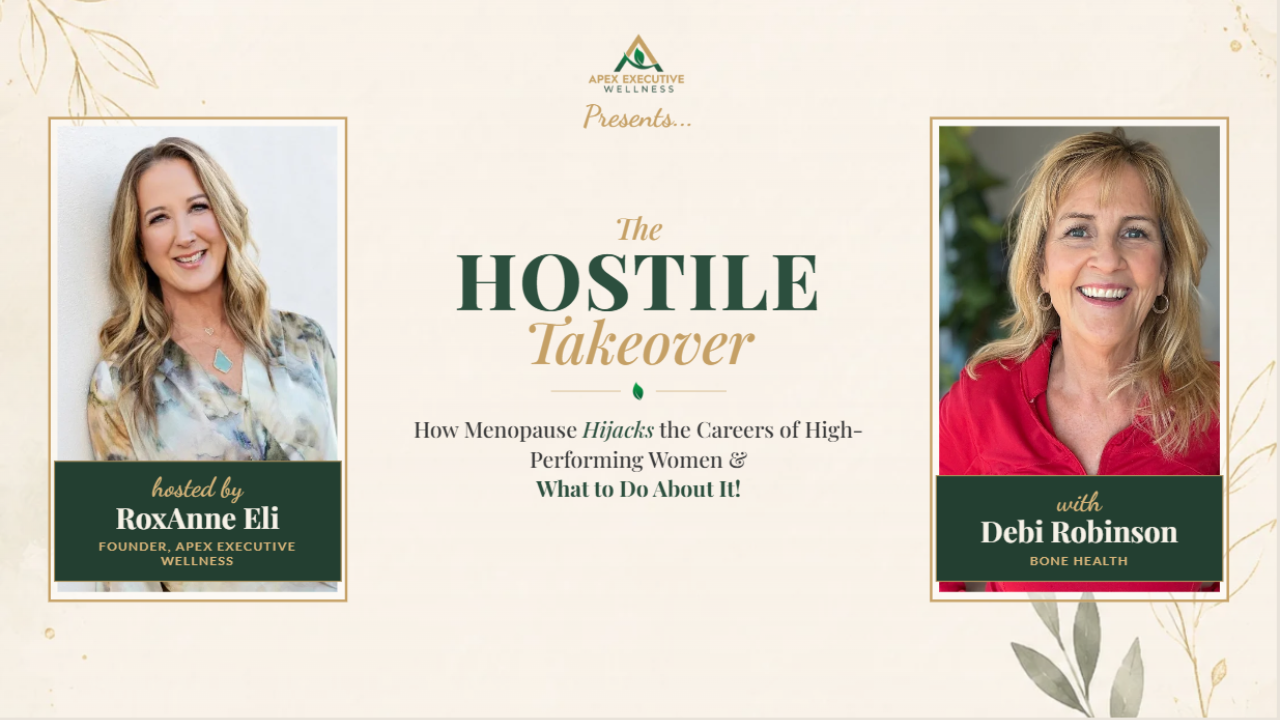
Full Transcript Introduction to Debbie Robinson 0:00 All right, welcome Debbie. I'm so glad 0:02 that you could join us today. I'm so 0:04 excited to present to you, my audience, 0:08 Miss Debbie Robinson. She's amazing. She 0:11 is a functional bone health expert. Uh 0:15 she's also a certified yoga therapist, 0:17 which I thought was fascinating when you 0:18 and I first talked. Um and she's also a 0:21 podcast host and an educator. and she 0:24 helps women naturally build stronger, 0:28 more fracture resistant bones. And this 0:30 is going to really important 0:31 conversation, Debbie, for our audience, 0:34 those high performing females 45 and 0:37 above kind of going through those 0:39 hormonal changes. Um, and so what's 0:42 interesting about Debbie is after 0:44 undergoing total hip replacement 0:46 therapy, bless your heart, at age 51, 0:50 she later discovered their her own bone 0:52 loss because of this process, because of 0:55 this journey she went through. And she 0:57 became passionate about uncovering the 1:00 root causes of bone loss for females in 1:03 this age and really empowering women. 1:06 That's really their her mission is to 1:08 empower women, give them simple things 1:10 they can do to take back control of 1:12 their bones and their health. Um, and 1:15 really long-term strength and confidence 1:18 and healthy aging. So, welcome Debbie. 1:21 Glad to have you. Um, so just to kick 1:24 things off a little bit, I know, you 1:26 know, obviously you've gone through your 1:27 own bone loss journey and had to rebuild 1:30 it back, but tell us tell us a little 1:32 bit about how how bone loss or what did 1:35 you call it the um dissolving, I think 1:38 you said bone dissolving, how that how 1:41 the pmenopause, menopause 1:44 uh age range, how that accelerates the 1:47 bone health and the bone dissolving and 1:50 what's the biggest misconception you 1:52 think women have about this topic. 1:55 >> So there's a first of all, thanks for 1:57 having me. 1:57 >> Yes. 1:58 >> Um there's a more of a raised awareness 2:02 now around bone health. And there wasn't 2:04 before. The standard procedure of care 2:07 is that when you're 65, you get what's 2:09 called a DEXA scan, which is an X-ray to 2:12 look at your bone health. Now, bone loss 2:15 begins in our mid-30s. be the bone the 2:18 the overtaking of bone building versus 2:22 bone dissolving. So bone loss, I call it 2:24 bone dissolving because it really is a
How Bone Loss Accelerates After 35 2:27 process. Your bones are dissolving and 2:29 they're dissolving because they're 2:31 actually the banks of storing your 2:33 minerals and they store other things as 2:36 well. One of them being lifong exposure 2:38 to toxins. So your bones are your bank 2:42 and your your reserves and then whatever 2:44 needs the body has they will dissolve 2:47 those minerals into the system to help 2:49 manage the show. So up until age 35 the 2:52 bone building it outpaces the bone 2:55 dissolving component and then around 35 2:58 we see a shift and this is why if you 3:00 think about uh athletes especially 3:03 football players you don't see high 3:06 super super super super high performing 3:08 athletes past the 30s right you see them 3:12 in the 20s 3:13 >> and the and the 30s because that's when 3:16 our body is really maximizing 3:20 So, not to be a Debbie Downer and to 3:23 like thought, you know, my gosh, wait, 3:25 what does this mean? It's 3:26 >> no pun intended, right, Debbie? 3:28 >> Yeah, I'm a Debbie upper. [laughter] 3:31 So, it's not about doom and gloom. I 3:33 want to raise awareness that if that 3:35 shift is happening in the mid30s, what 3:37 are the components that contribute to 3:39 that? 3:40 Hormone loss is one of the biggest 3:43 because the biggest decrease in bone 3:45 tissue, bone density, bone tissue is 3:48 five to seven years post menopause. So 3:52 if you're in your 40s and if you're in 3:54 your 50s, just knowing where you are in 3:56 this trajectory, when once we start to 3:59 lose our steroid sex hormones like 4:01 estrogen, bone loss accelerates. 5 to 4:04 seven years postmenopause is the 4:05 greatest decrease. 4:07 >> Wow. So we already know that naturally 4:09 for as a woman that's something that's 4:11 going to start to happen. So then we 4:14 have to think of well wait a minute but 4:16 what are how does it accelerate? How can 4:18 I slow it down? How can I be in control 4:20 of it? And that exists Roxan. I mean you 4:23 as both of us are FDN's both of us are 4:26 functional health coaches. Both of us 4:28 run functional labs to uncover 4:30 dysfunction to help people get back to 4:32 function. 4:32 >> Yep. So, I want to raise awareness to 4:36 whoever you are, whatever age you are, 4:38 that if you are in your 40s, getting 4:39 close to menopause, that this process is 4:42 happening in the background where the 4:44 bone building is slowing down and the 4:47 opportunity for bone dissolving 4:48 increases. And then if those of you are 4:51 in menopause, that's when the biggest re 4:54 decrease happens. 4:55 >> Wow. And when you just said minerals, 4:57 that's fascinating because we know, 4:59 we'll talk a little bit about this 5:00 later, our high performing women are 5:04 under a great deal of stress and anytime 5:06 you have that stress, you just suck 5:08 minerals to keep keep those stress 5:11 levels to keep your body going. Is that 5:13 true? 5:14 >> Yeah. So, mineral depletion and because 5:16 your bones are storing the minerals and 5:17 we know minerals minerals are like spark 5:21 plugs they say, right? They're what is 5:23 running the show. They're they're 5:24 supplying the energy for the body to 5:27 run. So, we need to have those 5:29 optimized. Well, 5:31 >> what's your lifestyle like? Are you 5:32 burning the candle at both ends? And if 5:34 you have chronic stress in your life 5:37 without managing that stress, that's one 5:40 of the biggest bone dissolvers of all is 5:42 stress. 5:43 >> Right. Right. And it's such an important 5:46 such an important factor. It's really 5:48 it's really hard for high performing 5:50 women like us, you know, we're burning 5:52 the candle at both ends to remember that 5:54 even for myself. Remember, you've got to 5:57 take some time, you know, you got to 5:59 protect your bones. [laughter] So, no, 6:01 that's fascinating. So, you think the 6:02 what the greatest misconception about 6:05 bone loss in this age would be? 6:08 >> Okay. So, the greatest misconception is 6:10 this. So, do women in their 40s think 6:12 about bone loss? I don't know. I didn't 6:14 until I had to. Right. until I had a 6:16 collapsed hip at 50 and a total hip 6:18 replacement at 51. So bones became 6:20 something I had to pay attention to. I 6:22 don't know that most 40 and potentially 6:24 50 year olds think about bone health. 6:27 And the women that I meet in what I do, 6:29 they didn't know until they had their 6:31 scan. So our standard procedure of care
DEXA Scans and Bone Health Misconceptions 6:35 is to scan with a DEXA scan to give a 6:38 diagnosis. 50% of the women over age 50 6:41 are going to be categorized in a bone 6:44 loss state. either the disease of bone 6:46 loss called osteoporosis or the pre- 6:48 disease state called osteopenia. 50% 6:52 will be in that category. 6:54 >> Then the only tool the toolbox for 6:57 physicians are pills and actually for 30 7:00 years since the mid1 1990s is how we've 7:02 been doing this. That's a big part of my 7:03 mission is to raise awareness and to let 7:05 women know how that's the wrong way to 7:07 do things. Uh so we are raising 7:10 awareness for the 40-year-old crowd, for 7:11 the women who are in menopause that this 7:14 process is happening in your body. There 7:16 are lifestyle factors that are going to 7:18 contribute to it and raise awareness. So 7:21 the biggest misconception, if I'm going 7:23 to use that, is that as we age, our 7:26 bones get weaker. Hopefully, fingers 7:29 crossed, I won't be one of the ones that 7:30 will get osteoporosis. That's the 7:32 biggest misconception is that we don't 7:34 have control over it. That is the 7:36 biggest misconception. and we actually 7:38 have complete control over it. 7:40 >> Yeah. Yeah. Um and and quick question 7:42 along that. So you talk about the DEXA 7:44 scan as the standard of care. What do 7:47 you use? What what assessments do you 7:49 use to kind of assess where they're at 7:51 if they haven't had a DEXA scan yet? 7:53 >> That's a good question because you're 7:55 right. So standard procedure is go get 7:57 that DEXA scan. The DEXA scan is an 7:59 X-ray. And ironically, when the DEXA 8:02 scan was being created in the 90s, there 8:04 was a pharmaceutical company that had a 8:06 drug that needed to make money that 8:08 helped to fund it and blah blah blah 8:10 blah. Right. So, this perfect match of 8:13 50% of the women could be categorized 8:15 and guess what? I got your pill. 8:17 >> Yeah. [laughter] 8:18 >> One of the first blockbuster drugs ever 8:21 was that drug that came out in the 8:23 1990s. So what are the ways for us to 8:26 actually monitor if we know now that 8:30 it's lots of contributing factors? One 8:32 my one of my podcast episodes was 150 8:36 causes of bone loss. So if if we have 8:38 all these factors that are contributing 8:40 to bone dissolving that must mean that 8:42 we can actually monitor those and we 8:44 can. Okay. 8:44 >> So the DEXA scan is gold standard and I 8:47 want ladies to know especially if you're 8:48 petite that it misdiagnoses a very high 8:52 percentage of the time. So the 5 foot 8:54 three, three and below, 115 pounds or 8:57 below, anybody thin, low BMI, not going 9:00 to read your bones correctly. And so 9:03 that is a very large category, 9:04 especially Caucasian women in that 9:06 category. 9:07 >> Okay? 9:08 >> So the DEXA scan, you know, should you 9:11 get it, the insurance pays for it. So a 9:14 lot of women will do that. And you've 9:16 got to know that there's a huge margin 9:18 of error with the way it's done, the 9:20 person that's doing it. uh did they put 9:23 in the correct data? Were you positioned 9:24 correctly? Did you take a supplement 9:26 called strontium which will artificially 9:29 affect the numbers and it doesn't mean 9:31 your bones are less likely to fracture. 9:33 And the biggest thing for me Roxan is 9:35 that we all thought that this was going 9:37 to tell us am I fragile and breakable? 9:40 But recently the governing board for the 9:42 DEXA scan came out and said that the 9:44 DEXA scan the the bone density 9:47 >> is not a marker for fracture risk. So 9:50 that's what we thought it was, but it's 9:52 actually not. 9:55 >> Wow. I did not know that. 9:57 >> Yes. And the T-core, which is what gives 10:00 you your bone density reading, is 10:02 comparing you to a 30year-old or 10:04 mid-30s. 10:05 >> Now, me as a sexy, just became a sexy, 10:10 which means 60, 10:12 >> uh, I am 30 years or 25 years away from 10:15 what my peak bone density would have 10:18 been. So they're comparing you how far 10:20 away from that are you? And when you get 10:22 to this -2.5 standard deviations away 10:25 from that, that's when you have what 10:27 they call the disease state of bone 10:29 loss, osteoporosis. 10:31 Ironically, the highest number of 10:32 fractures is not in the osteoporosis 10:35 category. It's in the osteopenia or 10:38 nondetectable bone loss. And that's 10:41 because there's more women in that 10:42 group. 10:43 >> Right. Right. So just a lot of 10:46 misinformation and around this to begin 10:48 with. So really raising awareness to 10:50 that. So you asked then what should we 10:53 look at? 10:54 >> So what are the root causes? First of 10:56 all when we when we understand that 10:57 osteoporosis is not a disease of aging. 11:01 It is an inflammatory driven metabolic 11:05 disease like 11:07 diabetes type two like 11:11 obesity. Mhm. 11:13 >> Things that we actually have control
Root Causes: Hormones, Stress, and Inflammation 11:16 over. Heart disease. I mean, if you look 11:18 up how to reverse heart disease, how to 11:19 reverse diabetes type two, you will see 11:22 all these lifestyle recommendations. 11:24 Change your diet, manage stress, and 11:27 move differently, right? It's the exact 11:29 same thing for bone health. 11:30 >> Wow. Wow. Yeah. I don't hear a lot of 11:33 people talking about that. All I hear 11:35 is, "Well, I just need to take more 11:36 calcium." Is that Does that work? 11:39 >> You need calcium and vitamin D. 99% of 11:41 your calcium is stored in your bones. 11:42 So, it's a super important mineral. Now, 11:45 you need to find out why is your why are 11:47 your bones dissolving the calcium into 11:50 your system or why are they not taking 11:52 it into the bones? And there's a whole 11:54 there's the four musketeers of bone 11:56 health. There's the vitamin D that helps 11:58 calcium get absorbed. Calcium is a super 12:01 important mineral. You've got magnesium 12:03 that puts calcium into solution. And 12:04 vitamin K delivers the calcium to the 12:08 bones. And then there's a whole bunch of 12:10 uh co-actors that go into that 12:12 phosphorus, B vitamins, C vitamins, a 12:15 lot of other things, manganesees, boron. 12:17 So you have all of this that is a part 12:20 of the whole thing. And that's the whole 12:21 part is that it's really much more 12:22 complicated and not we've just done such 12:25 a reductionist 12:26 >> perspective of bone health for too long. 12:30 So calcium, I do not recommend calcium 12:32 supplementation. The recommendation of 12:34 1,200 milligrams is diet as well. And 12:38 because calcium is a structural mineral, 12:40 if you look at the labels of foods, it's 12:43 actually in so many foods. I mean, it's 12:47 in coconut milk powder or MCT oil 12:50 powder. It's in black olives. It's 12:53 everywhere. 20 milligrams here, 20 12:55 milligrams here, 20 milligrams here. And 12:57 what we really need is about 7 to 800 12:59 milligrams. That's what they do in the 13:01 UK or Europe. And if if all of those 13:04 countries were recommending 7 to 800 13:06 milligrams, if the science proved that 13:09 1,200 was what we need, you wouldn't 13:11 have this disparity between the the the 13:15 different like large groups that are 13:17 recommending certain, you know, RDAs or 13:20 >> right. So 13:22 >> that's a part of it, Roxan. Um, so in 13:24 terms I don't recommend taking calcium. 13:26 I re recommend eating your calcium and 13:28 getting it in your food. Well, I know as 13:30 as a fellow FDN, we always start with 13:33 diet. So much can be mitigated and 13:37 reversed just by consuming a a proper 13:42 diet. You know, instead of the SAD, you 13:44 know, typical American diet, eating 13:47 whole foods. And we're hearing that 13:48 messaging come out more and more these 13:50 days. But I I'm curious, speaking of 13:52 diet, I I believe I heard you um on one 13:55 of your podcasts talk about there's a 13:57 gut connection when it comes to bone 14:00 loss, right? Can you talk a little bit 14:02 about that? 14:03 >> Yeah. So food is the building blocks of 14:06 all tissue, including your bones. And 14:09 the journey from mouth to bones goes 14:12 through the gut. So we actually, yes, 14:14 need to eat high protein, yes, eat a lot 14:16 of minerals, but there's actually a 14:17 journey. First of all, mechanical 14:19 breakdown of food, especially protein. 14:21 We know now how valuable protein is. We 14:24 need protein to build more muscles 14:26 because more muscles, more muscle tissue 14:28 is going to maintain what you have in 14:31 terms of your skeleton and help to grow 14:34 your skeleton, grow your bones. So, we 14:36 need protein. We need to break it down 14:38 properly. So, we need to make sure from 14:39 a digestive aspect. You talk about diet 14:42 and it's not just what you eat, it's how 14:44 you eat it and what happens to it when 14:46 you eat it. It's all of that. It's the 14:48 what, the why, the how. And so, you need 14:52 that mechanical stimulation. You need 14:54 your body to be in a relaxed state when 14:56 you're eating because our gut is 14:58 innervated with the nervous system. And 15:00 if your body feels threatened, so for 15:02 anyone that's in their mid-4s, 50s, 15:04 burning the candle at both ends, 15:05 working, working, working, not 15:07 prioritizing self-care, not feeding her 15:10 beautiful bones, 15:12 >> eating on the run, eating standing up, 15:15 >> always eating in airports, eat just 15:17 grabbing a bar on the way to the flight 15:19 or, you know, in an Uber or Yes, I've 15:22 been there. 15:23 >> Right. And so when you're doing that and 15:26 you're doing it quickly and you're 15:27 trying to regulate your blood sugar and 15:28 you're not mechanically breaking down 15:30 the food, now it goes into your stomach 15:33 >> and in in your stomach, you need the 15:35 proper, you know, you and I run 15:37 functional labs. We run stool labs. So 15:39 there could be a bacterial overgrowth 15:40 that's getting in the way. There could 15:41 be not enough hydrochloric acid, which 15:43 is stomach acid, which does decrease 15:45 with age. And if your minerals are out 15:48 of balance, you need that sodium 15:49 optimized in order for hydrochloric acid 15:51 production. Yeah. Or if they have leaky 15:53 leaky gut going on. Right. 15:55 >> Right. Well, now we're going to go down. 15:56 So, we're in the stomach still. So, 15:58 stomach, you need all that. Now, you 15:59 come into the small intestines. And in 16:01 the small intestines, you have your 16:03 microbiome. You have the bacteria that 16:05 maintains the integrity of your 16:07 fortress, your gut lining. 16:10 >> If you This is where leaky gut occurs. 16:13 And there's a lot of things. There's 16:14 foods that contribute to leaky gut. If 16:16 you have that chronic stress response 16:19 and if you're not digesting properly and 16:21 you don't feed your beneficial gut 16:23 microbes and you don't feed your 16:25 fortress protection gut microbes, your 16:28 butyrate producing species that make 16:31 that mucosal barrier for protection, if 16:34 they don't get the food that they need 16:36 to maintain that, you now have things 16:38 spilling into your system. You're 16:39 triggering inflammation and osteoporosis 16:42 is an inflammatory driven disease. Wow. 16:46 Like most, right? Most diseases
Gut Health, Thyroid, and Early Warning Signs 16:48 inflammatory driven. Yeah. I know. I 16:51 mean, I just turned 59 and in my I was 16:54 42, I think, when I started going into 16:57 pmenopause and I remember having a DEXA 16:59 scan and back then they said I had 17:01 osteopenia back then, you know. So, 17:04 we'll talk a little bit later about what 17:06 what females can do about it because 17:08 that's really the main takeaway today is 17:10 what can the audience do about it 17:12 starting starting today. Um, I think one 17:16 thing I wanted to ask you is what are 17:18 some maybe some early warning signs? You 17:21 know, if the audience is listening today 17:23 and they haven't had a DEXA scan and 17:24 they're going through pmenopause, 17:27 what are some things they might be 17:28 feeling or or look for, you know? 17:30 >> Okay, 17:31 >> great question. So, because the food 17:34 needs to get from mouth to bones, what 17:36 are your digestive issues? Do you have a 17:39 daily bowel movement? Right? You should 17:41 have a daily bowel movement in the 17:42 morning. Sleep is when most regeneration 17:45 takes place in the body including 17:47 building bone tissue. So do you have a 17:50 daily bowel movement so that in during 17:52 the night your body was doing all the 17:53 processes it was doing and in the 17:55 morning you wake up and your bowels are 17:57 stimulated to remove whatever waste 17:59 products were bulked up, packaged and 18:01 created to be eliminated from your body. 18:04 So do you have gas and bloating? Do you 18:07 feel full too full quickly after eating? 18:10 Do you feel hungry after eating? Do you 18:12 have any acid reflux? Do you have 18:16 anything that would be digestive symptom 18:18 symptoms symptoms? That's one thing. So 18:20 that's like the gut symptoms. Then from 18:22 a nutrient absorption because what an 18:24 unhealthy gut is going to be triggering 18:26 inflammation, spilling toxins into the 18:28 system, uh not allowing your body to 18:31 optimize hormones that build bones, but 18:33 rather hormones that dissolve bones, the 18:35 stress hormone cortisol being the main 18:37 one. Um and the nutrient absorption. So 18:40 not having the proper building blocks of 18:42 bone tissue. So in order to see about 18:45 nutrient absorption issues, what about 18:47 your nails? Are your nails hard? Do they 18:50 flake? Do they peel? So the tissues of 18:53 the nails, the teeth and the hair are 18:56 very dependent on minerals and on 18:58 protein. So your hair, what is your 19:00 hair? Is it are you losing that shine in 19:02 your hair? Is your hair thinning? You 19:05 know, and and hair falling out can also 19:07 be uh a thyroid symptoms as well. And 19:11 thyroid is also linked to gut health 19:13 because our I told you that osteoporosis 19:16 is an inflammatory metabolic condition. 19:18 What runs our metabolism is our thyroid. 19:21 And thyroid actually the usable form of 19:24 thyroid hormone is created in the gut. 19:28 T4 is secreted by our hormone by our 19:30 thyroid. That's four iodine molecules. 19:33 It gets converted to T3 which one of 19:35 those iodine molecules is released in 19:38 the gut. The gut is playing a role so 19:40 that your thyroid can then stimulate 19:44 um metabolism. And I would say that that 19:46 could be another sign. Women who are 19:48 having sluggish thyroid, thyroid issues, 19:50 which happened to me, Roxan, when I was 19:52 going through pmenopause, I was first 19:54 diagnosed with thyroid after the birth 19:56 of my second child. I went on thyroid 19:59 meds for two months because I'm like, 20:00 "Oh, heck no. Am I going to be dependent 20:02 on a medication at 32? I'm so naturally 20:06 minded." And I did Chinese medicine and 20:08 blah blah blah blah. And I went off of 20:10 it. Got pregnant with my next kid. 20:11 totally fine until, you know, 15 years 20:14 later when I started going through 20:16 pmenopause when and I was a mother of 20:19 young children and I had my hip issue 20:22 and I was burning the candle at both 20:23 ends 20:25 and my hormones were going down. So, I 20:27 was in that place and then my thyroid 20:30 started to be sluggish and my gut was a 20:32 mess because I didn't know any better 20:34 and I didn't know I had I had not ran a 20:37 stool lab until I became started with my 20:40 training to be a functional health 20:42 coach. And so here I am with thyroid. 20:47 And I went on thyroid for a few years 20:50 until I then focused on gut health again 20:53 and got my hip replacement and figured 20:55 out my hip situation and then started 20:57 doing more self-care and more balancing 20:59 of my own body and went off thyroid meds 21:01 and haven't been on years. 21:02 >> Oh, good for you. Yeah, a lot of doctors 21:05 I'm on thyroid meds as well. Um, again, 21:08 didn't know anything about, you know, 21:10 the lifestyle or the gut connection or 21:12 anything. And I remember my doctor would 21:14 start me on the the T4. Um, and as you 21:17 mentioned, you know, it's kind of 21:18 replacing what your thyroid is supposed 21:19 to be putting out, but then the the T3, 21:22 the usable form was still low on the 21:24 labs. So, what did they do? They gave me 21:26 more T4. And, [laughter] you know, it's 21:29 like instead of looking at the 21:30 conversion factors in the gut, and I 21:32 think a lot of a lot of women are 21:34 dealing with that as well. So, um, yeah, 21:37 >> they are. So, that's a sign, right? 21:39 That's a thing. So, look at your 21:40 thyroid. what's going on with your 21:42 thyroid. So, check your nails, your 21:44 thyroid, your hair, and your teeth, 21:47 cavities, receding gums, those are all 21:51 going to be a part of what you need to 21:53 look for. 21:54 >> Okay. Excellent. Excellent. Now, I know 21:56 um we only have like I don't know 10 21:58 minutes left and I want to make sure 21:59 that we really help our audience 22:03 understand the things that they can do 22:05 today. And I I find it fascinating. 22:07 You're also yoga instructor as well, but 22:10 um what do you think are the most 22:12 important just simple daily habits they 22:15 could do? Like I could do, you know, 22:17 right after we get done talking. What 22:18 are simple things they can start doing 22:19 today that would help remmineralize 22:22 their bones. 22:24 >> Three areas to focus on. What you eat, 22:27 how you move, how you think, and how you 22:29 manage those thoughts every day. So 22:31 those are the three areas. So let's talk 22:33 about diet. There are foods that 22:35 dissolve bones and there are foods that 22:36 build bones. The foods that build bones 22:39 is protein and fiber. Fiber because 22:42 fiber is going to support gut health and 22:44 gut health is integral to healthy bones. 22:46 Healthy healthy bones. 22:48 >> So optimizing protein, making sure 22:50 you're chewing the protein, making sure 22:53 you're supporting digestion, you're 22:54 sitting, you're relaxing, your body 22:56 knows that it can actually take in this
Daily Habits to Rebuild Stronger Bones 22:58 food that you're bringing in. 23:00 >> And fiber, those are the two to really 23:02 focus on. And then hydration to making 23:04 sure you're hydrated as well. And not 23:07 just drinking more water, but eating wet 23:09 foods. So eating foods like vegetables 23:12 and fruits are high in water. So making 23:15 sure you're eating your water too in 23:17 foods. 23:18 >> And it's a different type of water. It's 23:19 like it's structured water, which is a 23:20 whole different subject, but that gets 23:22 into the cells um a little more 23:24 bioavailable than just slugging down 23:26 water. 23:27 >> Exactly. Yeah. And so then we have the 23:30 what shouldn't you eat? Well, you don't 23:32 want to eat foods that trigger 23:33 inflammation. And we know you and I run 23:36 food sensitivity tests. Food 23:37 sensitivities and really some of the 23:40 biggest triggers of inflammation happen 23:41 in the in the gut. That's where 80% of 23:43 your immune system is. And it's 23:45 foodbased. 23:46 >> Yeah. 23:46 >> So, the food that comes in needs to be 23:48 organic because you don't want to bring 23:50 in toxins and and trigger yourself that 23:52 way. And then the highly inflammatory 23:54 foods are gluten. And gluten is actually 23:57 really terrible for the gut lining. It's 23:58 terrible for thyroid function. And it 24:01 bile secretion, which is how we break 24:03 down fats. Dairy, and this is the 24:05 biggest one because many women think 24:07 they need dairy for protein, probiotics, 24:10 and calcium, 24:11 >> right? 24:11 >> And dairy is inflammatory. There's milk 24:14 proteins in dairy that's inflammatory. 24:16 And 60 something% of the world's 24:18 population is sensitive to lactose, 24:20 which is the sugar in milk. And there's 24:22 a growth factor in milk to quickly 24:24 accelerate the growth of calf bones 24:26 because dairy is actually made from cow. 24:29 It's a cow product, right? It's not a 24:31 human. It's not to build humans. It's to 24:32 build calves, 24:33 >> right? 24:34 >> So, you've got dairy, which is a big 24:36 shocker for many. I mean, really, it's 24:38 the biggest one. They're like, "What? 24:39 That's where I get my calcium, my 24:40 protein, and my probiotics." Um, and 24:44 sugar. So, sugar, dairy, and protein, 24:46 sugar, dairy, and gluten. 90-day 24:49 elimination can reset your body, and 24:51 then you can slowly reintroduce a food 24:53 one at a time to see how your body 24:55 responds. Mhm. 24:57 >> In my world, what women respond to the 24:59 most when they bring it back in is 25:01 dairy. 25:02 >> Really? Yeah. Now, we run, like you 25:05 said, a food sensitivity test. And so, 25:08 I've run them on my clients. I ran one 25:10 on myself recently. The number one 25:13 trigger for inflammation for me is whey 25:15 protein. Whey protein was number one, 25:18 which we all know is in the milk. Cow's 25:20 milk was number two. And then, 25:22 ironically enough, it was pears. Like 25:25 who knew, you know? So, you just never 25:27 know, right? You you think you're eating 25:28 great, you know, that I know many of our 25:31 audience listeners, they're like, well, 25:32 I have a good diet and you may very 25:34 well, but you just don't know. There 25:37 might be certain foods that are 25:38 triggering that you're like, if you just 25:40 eliminate those, you know, your world 25:42 will change. 25:43 >> Yeah. Yeah. 25:45 >> And the thing about pears is it's 25:47 mimicry. So, once your immune system is 25:50 being triggered in your gut, it doesn't 25:52 just mean that food. Because some people 25:54 say, "But I didn't eat any pears." It's 25:56 pears and things like pears. When your 25:58 immune system is making an immune 26:00 response, it actually makes an immune 26:02 response for this thing and things that 26:03 look like this thing. And when you are 26:07 not focusing on eliminating foods that 26:09 trigger, your immune system might be 26:12 really angry at a lot of things. And 26:14 sometimes I find a woman is sensitive to 26:16 43 items. And then once we do gut 26:19 healing and gut lining repair, the next 26:21 food sensitivity test, there's maybe 26:23 three. 26:24 >> Yeah. 26:24 >> So, it's really about healing your gut. 26:27 So, the 90-day elimination of dairy, 26:30 gluten, and sugar is what I recommend. 26:32 And then slow introduction. So, that's 26:34 that's the what you eat. It's what and 26:35 how you're eating it. So, make sure 26:37 you're supporting digestion. Then, let's 26:39 go into the movement. Fall and fracture 26:42 prevention top of the list. Lean 26:44 skeletal muscle. more muscle on your 26:47 body is going to support your bones. If 26:49 you're in your 40s, 50s, if you have 26:51 access to a gym, a trainer that that 26:53 knows about bone health and can guide 26:55 you safely, putting more lean skeletal 26:58 muscle on your body safely is important. 27:00 If you are beyond that or you have 27:02 issues in your tissues, you might not be 27:04 able to lift the heavy weights and it is 27:06 okay because you could still have strong 27:09 fracture resistant bones without heavy 27:11 weight lifting. The heavy weight lifting 27:13 studies show us that yes, women can if 27:16 they're able to lift heavy weights, but 27:19 it doesn't mean we have to lift heavy 27:20 weights to work on fall and fracture 27:23 prevention. As a yoga therapist, we need 27:25 balance. We need strong feet, limber 27:27 feet, limber ankles, communication 27:30 through your body from where are you 27:32 standing all the way up to your brain. 27:35 Proprioception 27:36 needs to be optimized and you need 27:38 hydrated tissues for that. So, you need 27:41 to make sure you're hydrated so your 27:42 body can communicate. Single leg balance 27:45 has been shown in studies that the women 27:47 that can stand on single leg for 30 27:50 seconds or more have a lower fall risk 27:52 and fracture risk. 27:54 >> Interesting. 27:55 >> Getting optimizing balance. And then for 27:57 those that are pretty good with single 27:59 leg balance, challenge yourself. Moving 28:01 your head is next level because that 28:03 brings in the vestibular section. So 28:05 when you're in a single leg, start to 28:07 move your head around. challenges 28:08 >> without falling over. 28:10 >> Without falling over. 28:11 >> Yeah. 28:11 >> And then the next level would be eyes 28:13 closing. So then close one eye, close 28:15 the other, close both. 28:16 >> Interesting. 28:17 >> So depending on So that's the balance, 28:19 that's the physical, right? Work on 28:21 building more muscle whether you're 28:23 doing yoga and holding poses longer. Um 28:27 I would say that the practice in yoga 28:28 slows down as you get older and the 28:31 practice of yoga slows down physically 28:33 for strength. So the venyasa practice 28:36 for aging bodies, for older joints that 28:38 become arthritic or have issues, you 28:41 slow it down, you go deeper in a 28:43 posture, and you hold it longer, and you 28:45 constantly refine it. Work on posture. 28:49 Um your your body's three scoops. You've 28:51 got a pelvis, which is the first scoop 28:53 of ice cream. Your rib cage is second 28:55 scoop. Your head is third scoop. Where's 28:57 your third scoop? Keep your third scoop
Where to Find Debbie and Final Takeaways 29:00 >> back. 29:00 >> Yeah. So you optimize your your posture. 29:04 So that's what you eat, that's how you 29:06 move. Those are t tips. And the last one 29:09 is what you think and how you manage 29:10 those thoughts. Stress management. 29:12 Stress will dissolve your bones faster 29:14 than anything else. All day, every day. 29:17 >> Yeah. Yeah. Well, I know that um you 29:20 know, we're running out of time here, so 29:22 I want people to know where they can 29:24 find more resources from you, where how 29:27 they can contact you, if you have 29:29 anything you want to share with them, 29:31 because there's so much to cover here. I 29:33 wish we had two hours. I could talk to 29:35 you forever, but where can they find 29:37 more information or or find you? 29:39 >> Okay. Uh, so Debbie Robinson, debi 29:43 Robinson is my website, which has 29:45 everything. Okay. 29:46 >> And then my messaging is a Stronger 29:48 Bones Lifestyle because it's all the 29:50 things you do, not just one. So, 29:51 Stronger Bones Lifestyle is my podcast. 29:55 It's my YouTube channel. 29:57 >> Okay? And 29:57 >> so, they could find me there. And then 29:59 I'm going to give a little free gift, a 30:01 strong lifestyle guide for you to share 30:04 with your 30:05 >> Okay, great. Great. Yeah, we'll put that 30:07 we'll put that in the notes in the in 30:09 the follow-up email to the free gift. 30:11 And what what is it again? What's it 30:12 called? Stronger 30:16 stronger bones. 30:17 >> Yeah, I was waiting I was waiting for 30:19 that um siren to go by. Oh, 30:21 [clears throat] the siren. Oh, no. Take 30:23 care of your bones. Take care of your 30:24 bones. Take care of your bones. 30:25 [laughter] 30:26 Stronger Bones Lifestyle Guide. So, 30:30 Stronger Bones Lifestyle is my podcast. 30:32 It's my YouTube channel and I'm going to 30:35 create a Stronger Bones Lifestyle Guide. 30:37 >> Oh, excellent. Okay. Yeah, there's 30:39 there's just so much. Like I said, um 30:42 you know, part of this this master class 30:44 that we're doing, I I sought you out 30:47 specifically because there's very few 30:50 experts that I know out there like 30:52 functional diagnostic nutritionists, 30:54 functional health uh coaches, 30:56 consultants that focus just on bones. 30:58 So, what you're bringing to to the world 31:01 is so needed and so necessary. And I 31:04 just thank you for taking the time to 31:06 share with the audience today. Thank you 31:08 for your expertise and um yeah, I can't 31:11 wait to get that guide and start doing 31:13 my one leg balances. 31:16 Moving your head all over and closing an 31:18 eye or two. 31:18 >> Moving my head and closing my eyes. 31:20 Yeah. Okay. All right. Well, thank you, 31:22 Debbie. I hope you have a fantastic day. 31:24 >> Yeah. Thank you so much.
Comments