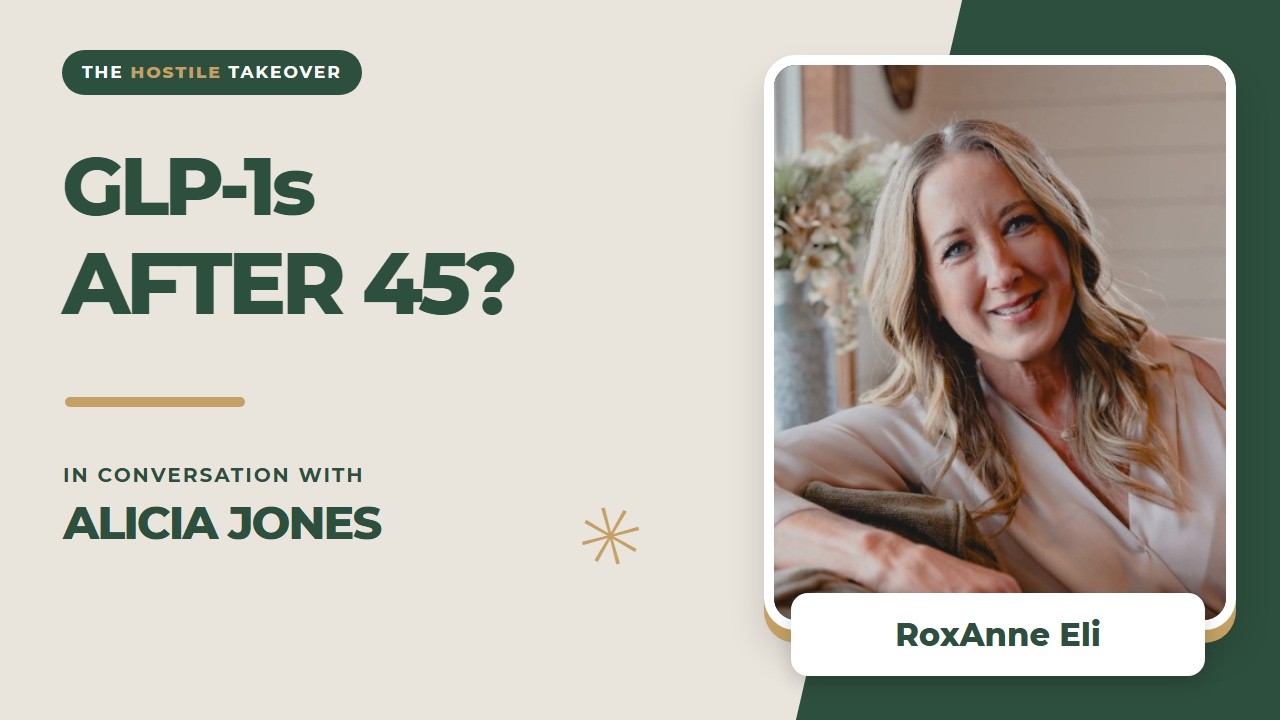
GLP-1s, HRT and Weight Loss After 45 | RoxAnne Eli with Alicia Jones

What should fitness look like when your body is changing and your calendar is already full? In this Hostile Takeover interview, I talk with Alicia Jones about weight changes after 45, questions women have about GLP-1 medications and HRT, and the role of food and movement in a realistic plan.
I’m RoxAnne Eli, MS, FDN-P, HHP, founder of Apex Executive Wellness. I help high-performing women navigate midlife health challenges that affect their energy, focus, and careers.
Book a free call with me: https://apexexecutivewellness.com/book-a-call/
This interview is educational, not individual medical advice. Discuss medication, hormone therapy, and changes to your health routine with your healthcare professional.
#Menopause #GLP1 #FitnessAfter45
Full Transcript
Introduction and Alicia's Background 0:00
Hi, Alicia. Thanks for joining us today. I'm so excited to talk to you. I think just the audience is going to adore you and love everything you have to say. So, welcome. Appreciate >> Thank you so much for having me. I'm really excited to be here. >> Good. Well, um I'd like to tell the audience a little bit about you. So, I'm going to read the bio that you provided because it's just it's impressive if I must say. So, Alicia Jones, welcome. She helps transform the health of lives health and lives actually of women over 45 through her fitness and weight loss strategies.
Alicia has appeared on various health and wellness television programs and produced and hosted Health Matters and The View Health and Wellness on Rogers TV. Very impressive. So, Alicia, she has a BA in kinesiology and a ton so many certifications we couldn't list them all here today, but um some of them include the National Coach of Canada, uh advanced sport and nutrition. She's a certified group fitness instructor, a personal training specialist, and one of the latest certifications she just uh received recently because of all of her clients asking her about it was the GLP-1 education for fitness professionals. So, anyway, I'm super excited to talk to you. Thank you for joining us.
>> Uh well, thank you again for having me and there's so much to dive into. So, I don't even know how we're going to get it in in like 30 minutes. I don't I don't know. >> [laughter] >> I know. I know. Well, after we get done here today then the audience will have a link to your website. They can reach out to you. You can chat with them as much as you want. So, yeah, there's so much. Well, um I'd like to start off with Can you give us a bit about, you know, we know your background, but what prompted you really to work with women over 45 and which women over 45 in particular?
Like kind of what prompted you and and why? >> Yeah, so I ended up working with women over 45 because it started when there was almost like this shift, this fork in this road for me when I was like if we don't take care of our health and well-being, things could look really different. I grew up in a family where my grandmother was the main one taking care of me because my mom was working. She was a single mother doing the the like out there coming home really late. She was So my grandmother was the one that was taking care of my brother and I. But my grandmother grew up in a time when smoking was considered the norm. Like she had been a nurse, but she smoked because that was Back then you didn't know like smoking was bad for you. You didn't have the same education on health and well-being that we have now. And so by the time she was taking care of me, she had COPD, cardiovascular disease, and she couldn't take care of me. And the the bond that you have like I don't know about you, but my grandmother was
Why She Works With Women Over 45 2:53
everything to me. >> Mhm. >> And it really like it hurt a lot that she wasn't able to be the main caregiver. We had to get babysitters that came in as well because she just didn't have the energy to do that, but she lived with us. But then years passed and she passed away. And my mother now she was rounding the age that my grandmother was when she died. And my mother was the opposite. She had a lot of education on health well-being. She did her fitness classes and ate pretty well. And so at my grandmother's age, she was like active, fit, healthy.
And I had already been in the fitness industry and here I was trying to get all of these fabulous women who are really busy in their lives to do the CN Tower climb, which here in Toronto like close to Toronto, it's it's like a thousand over a thousand steps that you have to climb for charity. And I was like, "Okay guys, we're all going to do this." And all my clients already had started to be, you know, they're corporate women who are in their like 40s and 50s. They're like, "We're too old for this. We're not going to do it." So, I recruited my mom to do it because she was 72 and the slogan was, "If she's 72, so can you?"
And so, everyone was like, "We have to do it." And that's when I kind of was like, "Oh my gosh, you have two choices, really, as we age. Like, we educate ourselves, we understand what to do, and we try our best to be healthy and and implement that. And we either have the choice of being the role model that climbs the CN Tower and has the energy and vitality to be with family, to work long hours and have the energy to do that, or you're like I hate to say it, but like, you don't have the health. You're like my grandmother who had to lie in bed and sit on the sidelines as as we were growing up. And so, for me, that's when I really decided it was it was where I wanted to be. It was working with women.
And I do predominantly work with women who are career-driven women who, you know, don't have the time and the energy at this time to even think about, "Okay, we've got to do the fitness, but I've got to have have all the to-do's on the to-do list done, and things are changing on a daily basis." And so, it's like, how can you fit it in in a way that actually fits your lifestyle, your career, and all of the other areas where you want to have the energy and the strength to be fully present for those things. And you can't you can't do it unless you take care of yourself.
>> Yeah, and a lot of the a lot of the women and we work with the same the same set of women, they not only are they focused, you know, they've got this career that they've worked so hard to build, but now some of them are caretaking for their parents, and some of their, you know, children are mostly grown now, but sometimes they're still taking care of them or maybe even grandchildren, and they're just taking care of everybody else but themselves. And they just, you know, I hear that a lot. I I just don't have time. I hear that so often. I don't have time to do XYZ.
>> That's it. And fitness and nutrition and health is is this thing that's like, I would love to do that, but it's another thing on the to-do list. And I just can't. Like, it's it's got to be scratched off for right now. >> Exactly. Exactly. And I know when we were talking earlier, I'm excited that one of the end end discussions we're going to have is you're going to give them some tips and tricks, things they can do that won't add more to the do list, just make it part of their day. So, we'll we'll get to that in a minute, but um yeah, I know that the So, there's a lot of discussion these days. I got to bring it up because everybody asked me to about the GLP-1s. And I know you just, you know, did the certification for fitness professionals. Um GLP-1s and hormone replacement therapy, obviously for women in this age, really to help with not only the symptoms they're dealing with, but obviously weight loss as well, that they've gained weight as their hormones have tanked and, you know, that kind of thing. So, I'm curious to get your take on it. Like, what, you what did you learn, and what what do you think? And what do what does our audience really need to know about those, like the the dangers, etc. And if you could just start by introducing like, what is a GLP-1? Like, in case they don't know. Yeah.
>> Absolutely. And I think um I'm comping to like, I think it's a important to talk about HRT and GLP-1 both together and separately. Because what we're seeing in the workplace, in especially in corporate, is that 2/3 of of women going through menopause are using sick days and missing work because of their menopause symptoms. And um I think you said it really well when we were talking
GLP-1s, HRT, and Menopause Support 7:35
earlier about um the KPIs don't care that you have menopause, right? >> it was KPIs >> give a about your menopause. >> That's it. Yes, yeah. Like they don't care and and it's like all life is going the same speed around you, but you are struggling with these symptoms. And so, it's not only the symptom of, you know, brain fog, fatigue, anxiety that comes up, it's weight gain for a lot of women and it's weight gain in the belly, in the stomach specifically because you are dropping in estrogen. So, estrogen drops that you don't have the fat storage in your hips and your thighs, it comes to your stomach. And so, there's also this this shift in confidence, you know, like the a lot of the career ladies, you're amazingly dressed, you are looking so great, but you don't feel as confident anymore because there's this excess belly fat. And so, there has been a lot of questions that I've been getting about, just like you've asked me, about both HRT to reduce the symptoms and feel like yourself again, especially when you're you need to be on for work and the GLP-1s. So, I'm a believer and I think you are too that if you have tried all the things and it's not working, then and you don't have any more time, that's it, you've used all the time you've got and resources on it, then they're both helpful tools, but we have to be specific about who they're for. It's not just for everybody who's just trying to kind of blanket over things and be like, okay, this is the quick fix. I'm I'm going to use this instead because I don't have the time.
No matter what, whether you're on a GLP-1 or whether you're on HRT, if you don't do the foundational work of some kind, and it actually doesn't take that much time or energy, we'll get into that, but if you don't do the foundational work, it's really not going to help that much anyways. >> Right. I do I actually had a client about 6 months ago who was on a semaglutide and it just got to the point where it wasn't working for her because she wasn't doing all the lifestyle, um, you know, factors that were so important to support that to work. So, right, it's not a quick fix. You can't just take it and and ignore everything else. It's simply not going to work and then you're you're just left in a mess after you go off of them. Yeah.
>> Yeah, that's it. Or you're on it and you're like, "This isn't working for me. What do I do?" Yeah. So, to your question, uh, GLP-1 is a glucagon-like peptide 1. That's what it's called. It's basically it everyone thinks, "Oh, you're adding something into your body," but you're not. It's it's an exact peptide we already have. We have this peptide in our body. The difference between us having this peptide and using the drug is that in our body, in order to feel full, we get this peptide in and it lasts a couple of minutes. That's it. And then it goes away.
Okay. So, we have it inside of us. Um, what the GLP-1 drugs do is it puts more of what we already have inside of us, but it's long-lasting. So, instead of lasting a couple of minutes, it it can last like a week, right? And there's actually longer-term effects of it. So, if This is one thing I say to people, if you have uh, side effects, you may have those side effects up to a month because it is long-lasting within the body. So, >> us about some of those. >> Yes, so the most common side effect is gastrointestinal issues. So, um, you know, you feel really, really full, diarrhea, bloating, um, you feel nauseous.
Constipation is another side of it, yes. Um, that is the number one symptom. And another symptom that I think some people really like because they lose the weight is that you don't really have the same motivation to eat, which is great. But, when you take a look at the research, people only stay on those drugs for about 2 to 3 years unless they have type 2 diabetes. The The general lifespan of wanting to stay on the drug is 2 to 3 years because then you don't have motivation for food or love for food the same way. And let's be honest, food is a part of joy as a human.
>> Yes. >> Right? And so, when that joy is taken away from you long-term, it's no longer the same benefit of oh, I've lost the weight and you know, it it's not the same driver and so people decide to go off of it because they want that joy back again. So, that is another big reason that people get off of them. Um and again, you're more it's more of a probability to get off of them if you don't have type 2 diabetes because then you don't need that medication to live. >> Right. And I know you I know you work with women who are on them to help them with the lifestyle factors so that when they do, you know, decrease or get off of them, they won't gain all their weight back again. You know.
>> That's right. Yes, absolutely. And when we're talking about HRT, um your probability of weight loss in a healthy way while maintaining your strength, which is lean muscle, which is so important on these drugs, it goes up when you are on a HRT drug and on a GLP-1 drug at the same time. The probability of what? Um the um so, like uh you'll maintain more lean muscle and you'll see better weight loss results if you are on both an HRT drug and a GLP-1 at the same time. >> Yeah. I'm a I'm a huge proponent of BHRT, bioidentical hormone replacement therapy. I know I went on it probably 12 years ago and it was a game-changer. I mean, I'm just like, okay, I respect people's decisions if they don't want to, but I'm like, why?
>> Yeah. [laughter] Are you still on it or on them? >> Yeah, yeah, yeah, just done it maintenance, just enough. Because, you know, you know, as a 45-plus year-old female, our bodies don't make it anymore, you know? And by this time, especially the career-driven, high-performing type A women, your adrenals are tanked. And so, they're not making it anymore, either. And so, you don't have any left. So, just replacing what, you know, should I say should be there, but just replacing a little bit to give you the bone strength and maintain the bones, maintain the muscle, just a little bit to do that. You know, I'm huge >> I For me, it's the mental clarity. Um so, I'm like about 2 years in in perimenopause, and this year has hit me harder than last year. And I I own my own business. Obviously, that's a part of what, like, you know, like, um I'm an entrepreneur in this, and am all online.
And I've noticed that the brain fog is something that's shifted my productivity. And so, I've already started the research to go on HRT or to
Natural Lifestyle Strategies for Better Health 14:27
look into bioidentical hormones. >> Yeah, let's talk. >> [laughter] >> YEAH. OH, YEAH. OH, YEAH, WE'LL HAVE TO TALK. YOU'LL HAVE TO TELL ME >> at that. So, okay, that's so great, great information. I wish I wish we had a chat or Q&A right now, but um I know people can follow up with you and ask you questions later after they after they watch this. But, how can women, if they don't want to do, you know, GLP-1s or bioidentical, how can they like naturally improve their symptoms? How can they start to feel better just with the lifestyle factors alone, so they can reduce that brain fog, be more focused, have more energy, you know, lose some of the weight. What are some things they they might be able to do?
>> Yes. Okay, my first thing that I have to say is that a lot of people come to me and they think it's going to take a lot of time. Like, oh, you're going to ask me to go for a walk, and then you're going to go to the gym, and then da da da da da only eat XYZ, and I've got meetings that I have to, you know, eat the bagels for. I have no choice. It's not like I could bring my own Tupperware. So, what what are you saying to me? Like, what what am I supposed to do? It actually doesn't take that much time. Quality matters over the quantity of the workout that you do, especially as you're entering perimenopause and into postmenopause.
That it is so important, the quality. And so, you can either do one of two things, incidental exercise, which is everyday activities you're already doing in your day. You can just up them a little bit. Like, we were talking about you know, maybe taking the stairs at work. You're like, going up the stairs. Maybe doing some squats at your desk. You don't need a lot. What you need is to focus on the quality of your workout, but you definitely have to try and incorporate strength training because we are at this place where we lose lean muscle. And lean muscle is not only strength, but energy. Think about it. If you try and lift a bag or like your groceries, and it feels heavy, it's exhausting. It takes your energy, too.
So, you need to have your strength. It also helps with weight loss, and it helps with menopause symptoms. So, we do need to focus in on strength training, but you can do it in much less than 10 minutes a day. It does not need to be this huge amount. And it doesn't even need to be a day. It can be two to three times a week. So, 10 minutes two to three times a week. Come on, guys. We can find that amount of time, right? >> it into your day. I know when I'm out walking my dogs, they're old, so they walk pretty slow. So, I'll just do walking lunges.
>> Oh, there you go. Right on. >> and I'm like, I might as well do some lunges. Or when one of them is doing their business, I do a few squats at that time. So, yeah, I love that. Just incorporating it into your day like that. And I know that you you know, we've touched on the fact that these women, whether they're in corporate or they're entrepreneurs, we've already talked about they're they're just so busy. They don't need anything else in their day, you know, to add to their day, um, another thing on their to-do list.
So, can you can you give us some maybe just a few tips? Like, okay, uh, you mentioned the food. So, I'm at a corporate meeting. >> [clears throat] >> I just got back from, you know, I just I'm at a conference and there's just bagels and cream cheese and all the things. What am I supposed to eat? What can a what can a a female do in that situation? Just one one or two tips. >> Yeah, so I I think also that depends on what's being served, but usually what they do is sandwiches of some kind. And there's sandwiches that, um, you know, have your like turkey or whatever the case is. We also know that protein is really important, uh, as we age and as we're going into hormone shifts, it's really really really important or again, we lose the lean muscle and, um, like our we need to manage our symptoms as well. So, if you can find like the sandwiches that have the higher protein and you eat meat, uh, then go for those because it's going to give you more of the protein. If you can bring a shaker and bring a protein shake, like nice and easy because that's going to give you the protein, it's going to fill you up and it it's going to it's going to help satiate you as well as you give you that, uh, lean muscle. So, um, try and bring your own protein shake or put it in your coffee, you know? If coffee is already there anyways, just throw in some protein powder or have a protein shake that you can mix in with it, right? Nice and easy, super simple.
Yeah, and you can have it on the go, right? You don't even need to make some really complicated shake in the morning before you leave the house. Just grab some protein, put it in a shaker and go, right? Super simple. I know or a lot of them, you know, it's it's kind of the thing now. You see, uh, people carrying their water bottles, right? For environmental purposes as well, but just add some amino acid powder into that water bottle. Shake it up. At least you're getting some amino acids that can help build the muscle later. Simple things. I love it.
>> The research shows that it's better to have protein powder because the actual powder, like you're getting it it depending on the kind you get to like whey or pea protein because you're getting it as a complete protein package. So whey is an actual milk product for example and our body is able to absorb it better and use it. Like when we actually take amino acids unless you're an athlete which we've talked about you've got other things going. You are not an athlete if you're listening to this. You might be, I don't know, but for the most part not. You don't need amino acids. You need >> Okay, good.
Good. No, that's great. And then and then a few give us a few exercises strength training they can do throughout their day. >> Okay, let me say one more thing about the food too because a lot of times like there isn't like a meat option but you're like with bagels and muffins and that's it. So how about instead of taking the bagel and having the whole bagel which is often what we do cuz we're like there's nothing else and how about having half of it? It's still got the cream cheese. It's got the protein, the fats. You have half of it. That's a proper serving size and then you can focus on you know, I'm usually at lunches they give some form of salad and something like that. So you can do that.
>> Okay, okay, good. I love it. And I know though you and I could talk forever about the food aspect of things. >> Yes. Absolutely. >> reach out to you for more tips. Um >> So sorry, you wanted to talk about the fitness side of things, right? >> side. What are some fitness things they can do? Like you specifically are talking about you know, just movement in general is great but especially the strength strength training, you know, throughout the day. I don't have time to go to the gym, you know, I don't have weights in my house. What do I do?
>> Yeah. And strength training is really important but also for menopause and and for for weight and for feeling our healthiest, high intensity interval training is also something that we need to think about. But when you think of high intensity interval training, a lot of people say I don't want to get sweaty. I have meetings all afternoon. Like you want me to get gross and I don't have the time for that. But what uh many don't realize is that with high intensity interval training, we're probably doing it anyways in small bouts and we don't even realize it.
So for example, if you are late for a meeting and you start power walking to get there and then you're like, "Shoot. Okay, the elevator's not coming. I've got to take the stairs." You go up the stairs, you're out of breath at the top of the stairs. You just did high intensity interval training. >> Well, look at that. Okay. >> All it takes is for you to get your heart rate up higher, maybe you're a little out of breath, and then the whole purpose of high intensity interval training is that it's small bouts of all out intensity followed by less intensity. So if you went up the
Simple Food and Fitness Tips for Busy Women 22:08
stairs and you're out of breath, well, congratulations. After that, you're not going to be doing it again. That's your high intensity because then you're having a bout of rest afterwards. >> Great. Okay. Okay, I love it. And maybe just bring some bring some Sketchers or something to wear into work and then put on your heels afterwards. >> Yes, yeah. Or maybe like, you know, if you have to take the train in to work or something like that, maybe kind of push your luck and try and be almost on time for that train so you might have to run to catch it. Just try it, you know?
>> That that would just increase my stress level. >> Yeah, I know. I know. Although it would increase your heart rate, too, so that would help out. But no, no, no, I totally get it. Yeah. >> Well, I know as we were talking about earlier, you know, the clients we work with, every one of them is unique. You know, they all have their own challenges. They all have their own, you know, schedules in their day, and so that's why they reach out to people like you just to say, "Help me figure out what to do in my day with my situation.
>> Absolutely. Yeah, and the only way to find some form of consistency is that it's tailored to you. >> Right. >> Like it is not one size fits all. It's not the exact workout program that Susie was doing and she got these great results. No, you have to listen to what is going on with your lifestyle, your body, and your health. >> Yeah, and there's so many um health influencers out there, so much noise on Instagram and Facebook and commercials about do this and you'll get this or do that. You know, it's hard to weed through all of that to figure out what's actually going to work for you and your body.
>> That's it. I totally agree and a lot of them are just going on what worked for them and they do not actually have any research or understanding or proof of why that would work outside of their own results and I think that's dangerous, too. >> I agree. I agree. Oh my gosh, we could talk forever. Um where I know you have a special gift for our audience or an offer for them. Can you tell us about that? >> Yes, so I have a free masterclass where I talk about uh the three phase food and fitness formula every woman over 50 needs to know. Uh it's for 45-year-olds as well. It I actually have a huge influx of women that have been 45 to 50 coming in because again with the hormone shifts, they really want to know. And uh inside we talk about what to do to make health and fitness fit your lifestyle, your a exact age, your stage of life and uh you can get that. I gave you the link, so yeah, there you go.
>> Yeah, >> [laughter] >> and then it's um the link is Alicia, so it's a l i c i a, aliciajoneshealthyliving.com. That's the link to her >> That's my website and >> That's the website. Yep, and then we'll put a link um down below that shows the actual link to her to her masterclass. I'm definitely going to sign up for that. >> [laughter] >> You know, I think so. >> That sounds amazing. Well, thank you so much for joining me. I know you are a busy entrepreneur and you got your day scheduled, so I really appreciate it. I know my audience appreciates it and thank you. We'll talk again soon, I'm sure.
>> Thank you for having me. >> Okay, you're welcome.
Comments