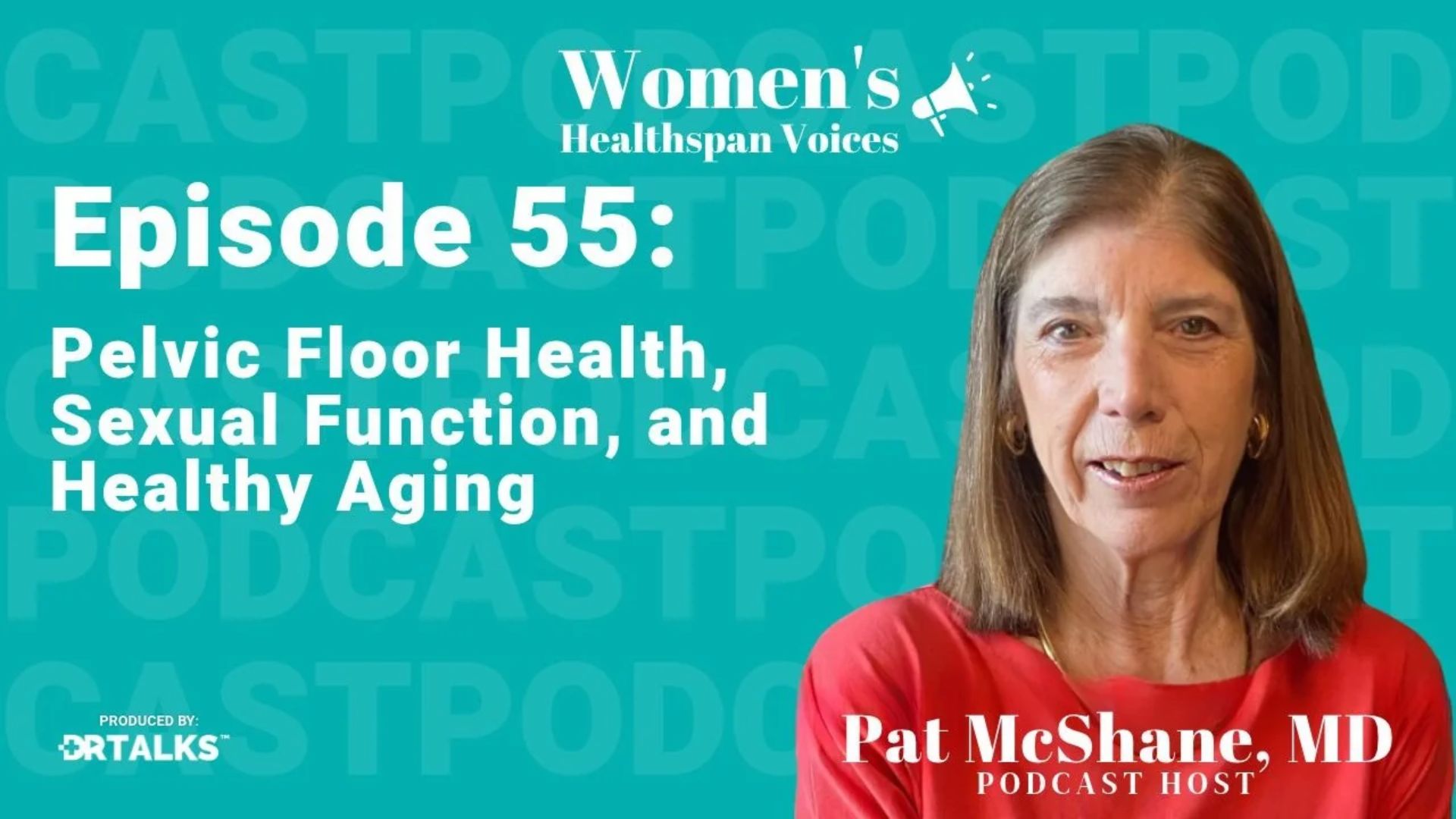
Pelvic Floor Therapy With the Vagina Coach: More Than Kegels and Bladder Control

Fertility Specialist (Retired)

- Discover how pelvic floor dysfunction can affect more than bladder control, including exercise, mobility, confidence, and social participation. Recognize why addressing symptoms such as urinary leakage and pelvic discomfort may help women maintain their independence and quality of life as they age.
- Understand the connection between menopause-related tissue changes, pelvic muscle function, and sexual health. Learn why vaginal dryness, painful intercourse, urinary urgency, and difficulty with sexual response may have multiple contributing factors that require individualized assessment.
- Learn why pelvic floor care involves more than Kegel exercises and how physical therapy, breathing techniques, functional movement, and appropriate medical treatments may help address different symptoms. Find out why seeking professional guidance early can support a more personalized approach to pelvic health.
Full Transcript
I always equate it to, if we had the same PR that the dentist had, the dentists from a young age, we've brushed and we floss, and go to see our dentist once or twice a year.
And we go even if have no problem. We just go for our checkup. I truly think we should be doing the thing with our pelvic floor. The pelvic-floor muscle training is our brushing and flossing.
Vaginal estrogen and all the other things are our flushing and brushing. Then we see the pelvic floors PT to screen and assess Because things do shift as we are aging.
And are my organs shifting? Am I still able to contract and relax in a balanced way? Do you see any skin changes that could indicate an autoimmune condition or genitourinary syndrome or menopause?
Have you made it past menopause, or are you going through it now? I'm Dr. Pat McShane, and on the Women's HealthSpan Voices podcast, I'll guide you through the health challenges of the menoppausal years and beyond, guiding the way to thriving in this powerful era of your womanhood.
Hello and welcome. I'm Dr. Pat McShane and I have a marvelous guest with me today on Women's Health Span Voices and that's Kim Vopney. She is known as the vagina coach and she is a certified personal trainer, a menopause support practitioner, author, a published author and the CEO of a company that works in the products for pelvic health sphere and maybe you can tell us a little bit more about that Kim.
We're going to talk more broadly today about pelvic and then how vaginal and pelvic impacts on sexual health. So stay tuned for that. One of the issues that came up when we started talking about this episode was that failure to maintain pelvic health has posed a threat to our longevity.
And I asked Kim if she'd be willing to tell us a little bit more about that, Kim, welcome. Great to have you with us and please jump in. Yeah, thank you very much, I appreciate you having me.
I am grateful for anybody who helps us get this conversation out there into the ears of people because it's something that a lot of peoples struggle with and I'm hoping to play a role in helping end that.
For sure, and sure you will. Yeah. So the longevity piece is really when I think about the people who I have supported over the years, even watching now my own aging parents, continence becomes, you know, I remember just a couple days ago, my dad was joking about plumbing problems.
And it's something that we have kind of accepted as this inevitable part of aging. I look at it as being a catalyst for some of the diseases of ageing, because when our pelvic health is working well, working optimally, it's not something we even think about.
But when it is not working, optimaly, It takes away our joy. It prevents us from exercising. We know from research, 46% of women stop exercise because of their pelvic floor symptoms.
in the general and elderly population have an increased risk of falling. We know that it's a leading cause of nursing home admittance. People stop socializing.
They stop committing to activities because what if there's no bathroom close by? What if I leak? what If there is no place to change my clothes? All the things that take away our joy and our confidence and freedom, and really robs us of our quality of life.
And then the sedentary lifestyle that happens as a result of thinking we're protecting the pelvic floor, then increases our risk of cardiovascular disease, metabolic health, so on and so forth.
Yes, definitely. We talk a lot about many of those factors on this show, quite on a frequent basis, and I'm glad that you emphasized that today. I am surprised about the falling piece, but I guess, again, if you're not exercising and you are not out there that much, it becomes harder.
Yeah, there's the hip challenges, balance challenges. There's waking in the night to pee. If it's middle of the day, you're going to feel groggy. It's going be dark.
That's one thing. But then if you also don't have the quick reflexes anymore, if the core stability we need to catch us if we trip, then it just all culminates and increases our risk factors.
And then there's also urinary tract infections, which often become a source of sepsis, a total body infection that can be extremely serious, and this is a frequent cause of mortality in very elderly people.
It can be a reason that an otherwise healthy woman would land in the hospital or even the ICU. So that's a big piece of it. Well, thanks for clarifying that.
It's great to get a different perspective. And one thing about this diagnosis of pelvic floor disorders has been that it's been neglected. People are either unwilling or ashamed or there just hasn't been the support for the research in the field and maybe you'd like to talk a little bit more about that.
If we hear of anything to do with the pelvic floor, it's usually once we have a problem or maybe along the way we've heard the term Kegel exercises and really that's the only pelvic health education we ever really received.
And to think of this really complex part of the body being only offered one solution of a Kegel exercise is we're missing a whole lot, really. And we deserve information much earlier in life.
I believe when we are teaching kids about sexual health and about bodies and menstrual cycles, we should be planting the seed of the importance of this group of muscles, male and female, called the pelvic floor, that is part of our core control and stability, and that we're bringing it into the fitness that were also teaching the kids.
And planting this seed that it plays a role in sexual response, it's our continence, its our organ support, I mentioned core-control. It works in synergy with our diaphragm to act like a sump pump.
All really important things, and we have these practitioners called pelvic floor physical therapists who we would benefit from seeing once a year, just like we see the dentist.
So once you become sexually active, seeing a pelvic or physical therapist once year as a checkup, even if you have no symptoms, could help screen for these conditions that can become life altering.
And we also know that pelvic dysfunction is not something that only happens to people who've given birth or only happened to the elderly population. This can happen to anybody, young athletes, trampolinists, gymnasts, tennis players, basketball, volleyball, soccer, rugby, you name it.
It can happened to people who we look at as being very fit or they're too young to have these conditions. People who've never given birth before, never even been pregnant before.
And yet we have an association that it's only something that's pregnancy related or only that is elderly related, or it is only we need to pay attention to if we had a problem.
And when we start to look at the statistics, from an incontinence perspective, throughout the years, it usually hovers around this 30 to 40 percent. I think that number is higher.
So many people just accept normal, like accepted as something normal. But 30-40-ish percent mainly urinary incontinence, anal incontinent, a lower percentage, that's much more life altering.
Then there's the pelvic organ prolapse bucket. 50% of women who have given birth have some degree of prolapsed. Early stage prolapes is often asymptomatic, so many people don't even know.
And it's important to know that you don, as I said before, you have to have been pregnant at any point. Yes, we know pregnancy and childbirth increase your risk, but prolhaps can happen to anybody.
doesn't have to just be somebody who's been pregnant. And then we have the pelvic pain population. There's so many different types of pelvic pains, and there's various percentages or prevalences based on those.
But generally, 12 to 18-ish, sometimes upwards of 23% of women with pelvic disorders. So these are not just, it's not a small percentage. It's a large percentage of our population.
Half of women in the world and then we have half of those people experiencing these challenges. Had we known earlier, had we had that seed planted, have people been able to make informed choices about care, things they did, if they understood things, root causes like constipation, chronic coughing, Not to say that any of those things are bad and sometimes beyond our control, but they are contributing factors.
It's not a Kegel deficiency. And we can't just then throw a kegel prescription at every single person. We need to have a much broader awareness understanding of the prevalence of different types of disorders, the root causes of them, and then the appropriate nuance of fitness and lifestyle solutions that can help them overcome.
I'm encouraged that many women now during pregnancy and immediately after birth are offered or encouraged, I presume, to see a pelvic physical therapist and so on.
But it probably needs to continue, as you said, into your 40s and 50s. I presumed that for most of these conditions, earlier is better. You can stop somebody's mild incontinence a lot easier than you can when they're in full-blown urinary incontinence.
And they may actually need surgery by that point, which most people will never need, surgery for their condition, but not if they've ignored it or have been poo-pooed by somebody.
Yeah, and the two points that if I can highlight on that, the surgery piece, People are often offered that. So if they have been, doesn't matter how long they've been suffering, but if go to their doctor for this, they may be told that surgery is their only option and sent down that path.
They may have surgery and then think their problem is fixed. And I want to highlight that in my opinion, it actually increases the need to do pelvic floor muscle training, to pay attention to the tissue support, make sure all of the contributing factors like constipation and posture and coughing are all under control.
It's even more important after surgery, especially if that person has been offered a hysterectomy or has had a hysterectomy. The other thing I wanted to highlight was when you said there's more people prenatal postpartum who are seeing a pelvic floor PT.
That brings me so much joy because that's how I started. So back 22 years ago, when I start to this, it was very much in that pre-natally post partum world.
And it's now only in the last kind of five-ish years, eight years maybe, that I see fairly regularly now people in this phase of life, they do know about pelvic for PT, They are, seeing them.
It is part of their pre natal, their post-part um, The majority of the people I work with now are in sort of that perimenopause, post-menopausal phase of life.
And now I look at the trajectory of how long it took from when I'm not saying I was the first person talking about it, but when pelvic health was kind of starting to be talked about to now, that's 15-ish years.
So we now have to expect that maybe in another 15 to 20 years, the people going through menopause at that time will have known about and known it along the way.
But you're right in that I view this as something, again, we should learn about, and practice through our life phases. It is not something we just do to, quote unquote, fix a problem and then we're done.
this really should be part of our overall fitness. And my teaching and many others, not just myself, but we take a whole body approach and train the pelvic floor dynamically, bring the pelvis floor into our whole-body workouts instead of just trying to train it in isolation with a Kegel practice.
It doesn't build the true capacity and resilience that we need in the Pelvic floor. just a quick word on catching the docks and probably the midwives as well up to par because I think for many of us certainly I trained back in the day when again kegels or keggles were the only thing that we had so there's a need for that and I know you're personally involved in some courses for medical providers I'm not sure who you aim your content for primarily so if my message here besides that thank you for doing this and and more docs should be seeing this kind of material, is if a woman with symptoms, it feels like she's being blown off, basically.
Go see somebody else or directly to a pelvic PT person yourself. So maybe you could comment on that. In my opinion, It takes a village for all of our health, including our pelvic health.
And I don't want to take away from the role that a medical provider would play. But in my opinion, the best first line of defense for our pelvic health would be to see a pelvic floor physical therapist.
And why I believe that is because they have more time, they can do a more thorough functional assessment and help screen for if there is a medial need and then refer on to the medical provide.
What I haven't seen happen regularly yet is the medical community doing the opposite. They have less time, they are trained in pharma and surgery, which can absolutely be the right option for people, but they aren't as often referring on to the pelvic PTs.
So I would want the first step to be pelvic PT, then add the layer of medical if needed, But so often it's not or not needed yet. The other way around.
Yeah. And I bet you that you all catch things a lot earlier and can balance out earlier problems with some muscles being overactive and others underactive, the imbalances in the pelvis and so on.
So that's great advice. Yeah, and again, it's not to, we benefit from, like, a lot of people will still see their OB-GYN or their UroGyn every year or family doctor a year.
Absolutely. And I also recommend you see a pelvic floor PT once a If we had the same PR that the dentist had, the dentists from a young age, we've brushed and we floss, and go to see our dentist once or twice a year.
And we go even if we have no problem. We just go for our checkup. I truly think we should be doing the thing with our pelvic floor. The pelvic-floor muscle training is our brushing and flossing.
Vaginal estrogen and all the other things are our flushing and brushing. Then we see the pelvic flooring PT to screen and assess Because things do shift as we are aging.
And are my organs shifting? Am I still able to contract and relax in a balanced way? Do you see any skin changes that could indicate an autoimmune condition or genitourinary syndrome or menopause?
So I just feel like it could really truly change the world if we had this preventive, regular kind of checkup mentality for our pelvic health as well as our oral health.
That makes a lot of sense given the prevalence that you cited of, probably 30% of senior women, older women have some degree of incontinence or other pelvic health problems.
So I think that's great advice. And when you think of now the explosion of the conversation of menopause, when look at that, the pelvic-health kind of component of Menopaus, genitourinary syndrome of MENOPAUSE, upwards of 80% experience one or more signs of GSM, genitourinary urinary syndrome or menopause.
And when I talk to women in that age group, most of my community is sort of 55 to 70, 75. So many of them have either never heard of vaginal estrogen or they've been denied vagin estrogen.
When it is the number one, I would say therapy that could help with all of those things. And we have research about my bias supports vaginal estrogen with pelvic floor muscle training.
Having better remission rates for moderate to severe in the study was vulvovaginal atrophy, but GSM. So as we age, I don't like saying that it's because you're getting older that you have these issues, but it is part of aging.
We lose muscle mass, we lose bone, estrogen, hyaluronic acid, collagen, all these things. And it can be a bit of an upward battle if we wait until we're 65, 70. If we had this information ahead of time, And if it was just kind of part of our practice, then this menopause transition wouldn't come with so many additional struggles or layers that we weren't really prepared for.
So I think that screening and having your care team, but also then understanding this transition period and how prevalent it is knowing you're not alone and that there's a lot of therapy and not therapy, but therapies that can help you.
It takes away this thought that I'm going to need surgery or I just have to wear pads for the rest of my life or, I guess, this is just the way that it or it's just part of being a woman.
I think that was a great summary and I'm hoping that the new FDA labeling will help with that regard and that practitioners who do see people on an annual basis for the most part will be more willing to open the discussion about systemic estrogen as well, bioidentical hormone replacement therapy.
and in particular vaginal estrogen. So speaking of the genital urinary syndrome of menopause, I'd like to shift our focus over to the sexual side of things, which In a couple of our earlier podcasts, we spoke about general ideas of pelvic health but didn't really talk much about the sexual issues that arise on a frequent basis.
And I'm sure this is one of the things that people may not be coming in with this at the forefront of their conversation, but with a little bit of digging, you find many, many sexual issues in the women whom you see.
And you could tell us a bit more about that. Yeah, I think pelvic health really should be a vital sign. There should questions around function and it could be, you know, are you pooping well?
Do you leak when you pee? do you have sudden strong urges? What's your sexual response? Are you able to have an orgasm? Can you accommodate touch and insertion?
And some people would start to squirm or feel uncomfortable with those questions, but many people welcome that somebody has actually asked them because there are a lot of people who struggle.
And with genitourinary syndrome of menopause, we have genital signs and symptoms, urinary signs, and sexual signs. So it's a syndrome, meaning it is a collection of signs all kind of a hallmark of this menopause transition.
And it's not just the loss of estrogen. In my opinion, it is the kind like the straw that breaks the camel's back. We have experienced muscle loss along the way.
It is not part of the body that we have been historically you know, really paying attention to or exercising. So it is maybe not functioning at its best.
And then we now get this to this phase of life and this loss of estrogen is just sort of like, okay, now things are either showing up for the first time or symptoms that have kind of been maybe sort manageable are really starting to come to the forefront.
So the genital signs and symptoms can be things like dry, thin, irritated tissue, burning, itching, visible changes to the structures. So, the tissues may look a different color.
They may start to almost disappear. The inner labia, that clitoral hood can adhere over top of the cliteris. And this is doesn't happen like as soon as we reach our menopause.
This is years of, many years, of this loss of estrogen. The urinary symptoms are things like urgency, frequency, nocturia, waking at night to pee, sometimes burning with urination as well, stress urinarian continence, anal incontinence prolapse symptoms, UTIs, which we talked about.
And then we have the sexual signs and symptoms, which are often sort of at part and parcel with what we've already dealt with. So pain with touch, sandpaper sex, painful insertion, inability to orgasm.
And the piece that I want to highlight there that isn't, I don't think, covered as well in that definition as I would like is it could also be tight muscles in the pelvic floor.
If somebody has been experiencing urinary urgency, anal incontinence, pelvic organ prolapse, if they've had a painful sexual episode, there's this unconscious guarding that starts to happen and the pelvic floor is really what starts hold and shorten and tighten.
And that hinders blood flow circulation, function, tight muscles can become painful. Tight muscles also don't go through a range of motion or allow a arrange of motions to happen which we would need for especially insertive sex to happened and be pleasurable.
We need to have some understanding of is this because of loss of estrogen and hyaluronic acid and collagen? Is it due to lax muscles that we've lost tone?
is it really really tight restricted muscles? Is it because maybe there's prolapse and there is an organ that's in the way that is being hit by something that potentially being inserted?
So we need do a little sleuth work and again with the time that have with a medical provider Visits are typically, you know, seven to 10-ish minutes, depending on where you live and who your practitioner is.
Whereas a pelvic PT, at very least, would be a 30-minute, often an hour or 60- minute appointment. And we have more time to understand health history, do a more thorough examination, and be able to sleuth out some of that nuance to decide what is painful, what IS difficult from a sexual health perspective.
So tell us a little bit about the kind of therapy that might be involved besides the use of vaginal estrogen, which we talked about. Yeah. So a pelvic floor PT would not be, they would tell you to go to your doctor to get a vaginolestrogen prescription, or they may recommend some lubricants, some vagina moisturizers, and they recommend products that you could use at home.
In the appointment, a Pelvic PT can use manual therapy techniques to help in the moment in that session. For the patient to then go home, they may be given some breath work.
They may given stretch or release exercises for the pelvic floor. they maybe given or advised to maybe use a tool like a pelvic wand or a thera wand and this is a device that would be inserted into the vagina.
that would act similarly to a therapist's fingers or an extension of your own. It can sometimes be a bit awkward to reach all the way into our own bodies to access those muscles.
So the wand is an expansion of our arm and it allows us to feel around inside to find trigger points or points of tension or discomfort and use the wand similar to like massage therapy or pressure point work.
And that can be really beneficial for people to use at home. There are also things like red light devices and some could be external or internal. The two red-light wands that I really like have the red lights, they have and they have vibration.
Vibration can be, yes, potentially pleasure, but also when inserted, especially if somebody is guarding or has tension, If they are able to accommodate insertion and they turn the vibration on, it can help increase blood flow circulation and actually help elicit a greater relaxation response in the muscles.
So especially people who have a lot of tension or guarding, that could be another tool that they could use. But as I mentioned, breathing, understanding how the breath works with the pelvic floor and influences the pelvis floor, and also a technique called hypopressive breathing can be very helpful for down regulating tone.
And then certain poses or exercises like a wide leg child's pose or a happy baby or pigeon pose, even things like hamstring release, belly release. It's not always just about releasing the pelvic floor but also the surrounding hips, and surrounding musculature that often also is short or tense or guarding.
I recently read a review of using red light therapy for women who are on anti-estrogen agents for breast cancer. And I didn't realize that there were red-light vaginal devices available, but that's probably in its early years.
We may hear more about that over time. Yeah, there's one company, I was actually the distributor for them when I had an e-commerce store, you know, 15-ish years ago.
So it has been around actually for quite a while. And the other one has even external, they almost look like menstrual pads with red light built into them that people could use externally as well.
And one other thing I wanted to mention that there's been some research looking also at vibrators. So I mentioned vibration as being part of the benefits of the red light devices, but even just vibrators in general.
And this could be vibrator that are inserted. It could also be vibrations. There's one company that has some that it sits externally on the vulva and research around pelvic floor dysfunction and especially pelvic pain and sexual health challenges and the benefit of vibration to like as part of therapy as well can be beneficial.
for probably increases blood flow and just tissue, tissue viability in general. Yeah, exactly. Excellent. So there's lots of options, it sounds like, once the CAREFUL exam has been performed and a history and finding out exactly what, where the pain points are and so on, if it's pain.
Anything else I should be asking you about this subject that I didn't ask you? I mean, I think the main points that I like to get across to people are that pelvic health or pelvic floor exercise.
It's not something that we have to wait until we a problem to then start doing. I hope that at some point in my life, it's just part of our fitness. our pelvic floor is just brought, even last night, I was at a yoga class, it was a male teacher.
And it wasn't a pelvic health class or even a core class. It was yoga, class and yet he was bringing the terminology of pelvic flora and breathing and it's getting out there more.
So it is my hope that it just continues to be incorporated into our the movement practices that we are all benefiting from. I want people to know that it's also, though, never too late.
So if you're hearing this and you are 75 years old, it doesn't mean that its too later for you. You can make change at any age. The oldest person in my community who made really significant change is 93. She's 93 and she still came and took action and was tired of putting up with these symptoms.
So I really applaud her for that. My recommendations are, I think I've said pelvic floor physical therapy once a year for a checkup and then incorporate your pelvic for muscle training into your strength training or your yoga or pilates.
Initially, it feels like another thing on your to-do list to learn how because we have never really been taught. We have to understand how to activate and relax our pelvic floor and then how do to layer that into movement.
But once we understand to do that, then we can bring it into whatever it is that we're hopefully already doing from a strength or resistance training, or HIIT training, or yoga, whatever is, so that train the pelvic for functionally and dynamically.
I want people to know, yes, about vaginal estrogen. I do recommend it for all women from the start of their menopause for the rest of life. We do know from recent literature that it will reduce the risk of sepsis, hospitalization, and death.
And then I think the final thing is that Once you know, tell others. Tell your doctor. tell your friends. Because the more this gets talked about, the less silent suffering there will be.
I really truly view this as a big threat to our longevity is pelvic floor dysfunction. And it has historically been something we don't talk about or it's shameful or taboo.
It's a body part. It is a really important body. The more we can talk about it, the more practitioners will screen and ask about, it the less shame and taboo there will be.
And the most we move forward and just treat this with fitness principles, potentially medical, all the things. We can use all of the tools that we have, but we just have to start talking about.
You took the last part of my talk, which is every time at the end of the video I say, and if this is the kind of information you like, please tell your friends, because I totally agree with you and you said it so well, I won't repeat it.
I hope there's also more research and more money being put into this because I'm sure there is more still to come in this area. So anyway, this has just been a wonderful font of wonderful information and experience on your part.
And thank you so much for being with us today. Thank you. I really appreciate you helping get the message out there. Thanks so for the invitation. Pardon me for my coughing.
Sorry about the tickle in my throat. That's okay. We'll take that. No worries. Hope to see many of you again in our audience and our audio and video audience.
Thank you. Thanks for listening to the Women's Health Span Voices podcast. If today's episode spoke to you, follow the show and share it with a friend ready to take charge of her health.
And please leave a review. It helps more women find us.
Comments