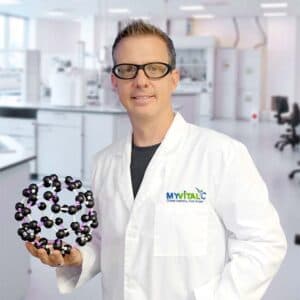
Full Transcript Introduction and Speaker Background 0:00 Ladies and gentlemen, welcome back to the Bioregulator and Peptide Summit. 0:04 My guest today. 0:05 Well, I've actually recorded at least one podcast on my own podcast 0:09 with Chris Burres. 0:10 He is the head scientist at ESS60, 0:14 and he is the published author of Live Longer and Better, host of the Live 0:18 Beyond the Norms podcast and patent holder with a surprising twist. 0:22 Not only is he a visionary scientist, 0:25 but also a master of comedy improv. 0:28 I didn't know that. No wonder I'm always laughing when I'm around you. 0:31 Chris Burres is the founder and chief scientist at My Vital Sea, 0:34 where he manufactures a Nobel Prize winning molecule responsible 0:38 for the single longest longevity experimental result in history 0:42 a full 90% extension of life, which I remember when I read that study, 0:45 I was like, Holy crap, even if it doesn't translate 100% over to people. 0:51 Pretty sweet. 0:51 He is the intersection where science meets laughter, and his life's mission 0:56 is to help people live longer, healthier, happier, pain free lives with science. 0:59 That's amazing. Welcome. Welcome to the summit, Chris. 1:02 Thank you. Natalie, thank you so much for having me. 1:04 And you know, when people can touch on my comedy improv, 1:08 I get a little bit nervous. 1:09 Now I'm going to have to actually entertain somebody there. 1:12 There is. The bar has been raised. Yes. 1:15 So I will save my biological analogy that starts with Mardi Gras 1:20 in at some point that will come out in this presentation. 1:23 All right guys, you heard it here. First. 1:25 Stick through the interview until you get to the Mardi Gras part. 1:28 All right. 1:29 So people might be wondering why is a C60 company 1:34 a part of a peptide and bio regulator summit? 1:37 And I to me makes all the sense in the world. 1:40 But let's talk a bit about this concept that you talked about before 1:44 we started recording, which was using C60 or S60 1:48 as hardware optimization for the software that are the peptides 1:53 and bio regulators that we would be introducing into our bodies. 1:56 Yeah. So I do have a presentation. 1:57 Is now a good time? We'll pull that up. 1:59 Whatever you're going to do to make it easier for the audience to. 2:03 And look first slide, it actually has you you're in the first slide. 2:07 Me oh my. 2:08 God that looking amazing as always. 2:10 Now I'll breeze through this. 2:12 We do want to keep this really tight. 2:14 There'll be a disclaimer. 2:15 We'll talk about optimizing peptides and bio regulators. 2:18 How do we think S60 works? 2:20 I'll actually talk about the difference in our mind between S60 and carbon 60. 2:25 Of course we've got a health disclaimer. 2:28 Our product has not been evaluated by the FDA, is not intended 2:32 to treat, diagnose, or prevent any disease. 2:35 We will probably be sharing anecdotes, not antidotes, anecdotes. 2:39 And I always just say, hey, just assume this won't happen for you. 2:42 Dig into the research. 2:43 If this really does resonate with you. 2:45 There'll be a link that will share at the end. 2:48 Just a little bit about me. You talked about this. 2:50 I've been working with this molecule. We'll dive into this molecule. 2:53 It's a Nobel Prize winning molecule. 2:54 Since 1991. 2:56 I have written the book Live Longer and Better. 2:58 I've also recently finished the book The Longevity Molecule. 3:02 I did a summit, which you like.
Peptides, Bio Regulators, and Mitochondrial Hardware 3:04 Again, I can't thank you enough. 3:06 I think you got somewhere between. 3:07 You helped me 3:08 get somewhere between 8 and 12 interviews, people that I could interview. 3:12 So that was fantastic. 3:13 That's called Uncovering the Secrets to Longevity. 3:16 I do have the podcast live beyond the Norms. 3:18 And then, of course, you can connect me on Instagram and YouTube. 3:22 I was recently on the Dave Asprey podcast, so that was really exciting for me. 3:26 I don't know 3:27 if anybody else out there is excited, but I was absolutely excited about that. 3:31 So here's kind of what I was talking about, that peptides 3:34 are this software and your physiology. 3:38 Right. 3:38 And even more specifically in this case 3:40 we're going to be leaning on the mitochondria as the hardware. 3:43 So if you've got great software and your hardware is dysfunctional 3:47 and you've had a recent experience like, you know, maybe the peptides were less 3:52 effective as you're going through 3:53 these kinds of experiences, I think that's really important. 3:56 So there's different receptors. 3:58 If you think about insulin it's going after the mTOR pathway. 4:01 You think about it. 4:03 And the IG one pathway BPC 157 your G.H. 4:08 I am reading this because you are the expert. 4:10 I'm a guy who reads these things. 4:13 CJC 1295 circadian Rhythm and regulation. 4:16 And then of course GLP one the GOP one pathway. 4:19 But if you're communicating and all you're dealing with 4:23 is these mitochondria whose Krebs cycle isn't 4:26 functioning, the electron transport chain chain isn't working. 4:29 You've got this oxidative stress. 4:30 You've got this inflammation again like the hardware is 4:34 is key to kind of drive this a little bit home. 4:38 How are these different regulators bio regulators 4:42 and peptides dependent on the mitochondria. 4:46 Well listen we don't have to go through 4:48 all these really it's about ATP production the energy production. 4:52 It's about nutrient efficiency. 4:53 It's about low oxidative stress. 4:55 Ultimately powerful mitochondria support these bio regulators. 4:59 By the way, if at any point you want to jump in, 5:02 wave your hand, I'll see you and we can get get you. 5:05 Otherwise I'm just going to let you rip and you know. 5:07 Yeah, I. 5:09 Just want to the right here what I will say and just to put it 5:13 in planar language for the audience, for those of you 5:15 who might be new to this space, if you happen to stumble 5:17 upon this interview, what we're really talking about here, 5:20 the mitochondria, which are, as Chris said, they're the their the engines 5:24 in your cells that produce energy for your body, that runs everything. 5:28 They also sense the environment. 5:30 They're very important signaling molecules when they don't function properly. 5:35 All these peptides you're bringing on to to effect 5:38 change are not going to be able to do what you want them to do. 5:41 So either you're not going to get results or you're 5:44 and you're just wasting your money, or things could actually go sideways 5:47 with the bio regulators because they're acting on the DNA of the cell. 5:52 You still can't bring a bio regulator peptide 5:55 into what Chris really, or referred to something else as a dumpster fire. 6:00 If the dumpster is on fire, 6:01 there's not much you're going to be able to do in there. 6:02 So this really gets to the root of optimizing the environment 6:08 and the terrain for these other small molecules to do their work. 6:12 Yeah. That's it. 6:13 So hopefully yeah. 6:14 Like you started with that question, why might a C60 or an S60 6:18 company be in a bio regular peptide. Correct. 6:20 Well I get to get the hardware right. 6:23 Here's a couple more. 6:24 Right. Tessa morrell and Morrell. 6:26 And again you're just back to better sleep quality restore cellular wellness. 6:29 By the way, 6:29 our most consistent testimonial is people take the product in the morning. 6:33 They report mental focus and energy 6:35 during the day and then better sleep that night. Right. 6:37 So that better sleep quality to kind of bring it back again. 6:41 You've got all these signaling molecules coming in. 6:44 Really. 6:45 If they don't land well then, you know, you're probably wasting your money, right? 6:49 And, you know, peptides tend to require injections. 6:52 There's some commitment. 6:53 And let's let's make sure that that hardware is where it needs to be. 6:58 So you can really reap the benefits to the max. 7:01 What are we even talking about? Right. 7:02 So is a 60 molecule was discovered in 1985. 7:06 There is actually a book called The Most Beautiful Molecule 7:10 because it is actually a beautiful structure. 7:12 I don't know how many molecules have books written about them, and certainly 7:16 not saying that they're beautiful. 7:17 So it's it's actually stunning. 7:19 And the three scientists, Doctor Smalley, Doctor and Doctor Kroto, 7:23 who discovered it, went on to win the Nobel Prize for that discovery.
C60 Discovery and the Longevity Rat Study 7:26 I like to share our lab started manufacturing it in 1991, 7:30 a full five years before they were awarded the Nobel Prize, 7:34 and may be a funny person, but I am not a very braggadocio person. 7:37 It is. This is as much as as you'll get from me. 7:40 It is not unreasonable to suggest that because we were delivering 7:44 commercial quantities of this carbon nanomaterial to research institutions 7:48 around the world in 1991, scientists could get their hands on it. 7:52 They could do experiments with it. 7:54 They could understand how impactful this molecule is. 7:58 Partly the reason, at least maybe the timing of when they won the Nobel Prize. 8:03 And this molecule is amazing. 8:04 Part of the reason they won the Nobel 8:05 Prize is the way I describe it, the molecule performs as well 8:09 or better than the current best material in almost every application. 8:13 So it makes better inks, better tires, better batteries, better photo cells. 8:17 This is where people get nervous because we're like, 8:19 is this a health supplement or nobody in your audience? 8:22 And I know your audience is like bio hackers, right? 8:24 Nobody woke up this morning, looked at their car battery and thought, 8:27 I wonder what part of my car battery I should be consuming on a daily basis 8:31 for my health? 8:32 No, as a matter of fact, you're sending people running for the hills. 8:34 But but I think that, you know, and I'm sure you're getting to this part, 8:37 the reason why it was discovered as maybe potentially having benefits 8:41 for live organisms, were the testing 8:44 that you have to do on animals to determine how toxic a molecule is 8:48 that's being introduced into the market, even for industrial purposes. 8:52 You're so good. 8:53 This is exactly right. 8:54 Like if man is going to if it makes great inks, batteries, tires and photo cells. 8:58 By the way, I really do hope the batteries land. 9:00 It is cost competitive with lithium 9:02 and a kind of a colloquial name for this is a Bucky ball. 9:06 I just think a Bucky battery should exist, like just on principle. 9:10 There should be a Bucky battery. 9:12 Yeah. 9:12 So in fact, this shape right up front, front and center is the same shape, 9:16 not the same formula, but the same shape as benzene. 9:19 Now benzene ubiquitous in our society. 9:22 If you need some a little bit of evidence, you look around you. 9:25 Everything that's plastic would be gone without the benzene ring. 9:29 But it is known that when benzene is on its own, it's known to be toxic 9:33 and known to be carcinogenic. 9:34 So because this shape exists 20 times 9:37 on the exterior of this cage, they assumed it would be toxic. 9:41 So they put it in a toxicity study. 9:42 And this is where things get really interesting. 9:45 In this study there were three groups of Wistar rats. 9:48 And again toxicity there were three groups of Wistar rats. 9:51 One group was given water. That's a control group. 9:54 One group was given all of oil. That's a semi control group. 9:56 And then one group given the S 60 molecule in olive oil. 10:00 And I'll share here because you and I are both familiar with this as C60, 10:05 we kind of picture the market this way where C60 is for industrial applications. 10:11 And there is peer reviewed, published research 10:14 that if you improperly processed C60, it's harmful. 10:18 S60 is C60 that's been processed for people in pets. 10:21 That's the the kind of separation that. 10:23 We tend to different. 10:24 Okay, I was wondering about that. Cool. I'm glad you clarified. 10:27 Thank you. 10:28 And so you can see, a typical Wistar rat usually lives out to 32 months, 10:31 which is exactly what happened in this study for those rats given water. 10:35 You'll notice here that the group given olive oil, they lived 18% longer. 10:39 So so like Ben Johnson, doctor Stephen Gundry, 10:41 like everybody who's coming out with olive oil, it's for good reason. 10:44 Olive oil is I love what Doctor Gundry says. 10:46 He says the purpose of food is to get more olive oil into your mouth. 10:51 That's how healthy olive oil is. 10:53 But that's still just an 18% extension of life, the one. 10:57 I think most people would take. 10:59 Yeah, no. 11:00 Like what. 11:01 Is not for nothing. That's almost 20%. 11:04 Yeah, it's going to be top 5% things you can do to extend your life. 11:08 Like in the case of this. 11:09 And these are Wistar rats. 11:10 So there's some you know what is how much of this transfers to humans, 11:14 which is an interesting and potentially philosophical question. 11:17 But you look here, we've got the SS 60 rats. 11:20 They lived out to 62 months, a full 90% extension. 11:24 I will share. 11:25 This is a study out of the University of Paris. 11:29 Our lab provided the material in our lab is mentioned in that original study. 11:33 So very proud to not only be the oldest 11:35 and longest manufacturer and distributor of the molecule, 11:38 but really to be the lab involved in the original study that kicked it off. 11:42 There was one other piece of the study, which is absolutely fascinating, 11:46 which is a typical Wistar rat will live 11:48 32 months, as we've said, and it will have a known amount of tumor mass. 11:52 You can see this tumor mass continues to grow. 11:55 The longer it lives, the more tumor mass it has in its body. 11:58 And, you know, if you were to project that out. 11:59 But the reality is, is those given those Wistar rats, given the S 12:03 60 molecule dissolved in olive oil, none of them had any tumors. 12:07 That's because there are two little tumor factories. 12:10 These guys. That's why they're used in clinical trials. 12:12 Right? Yes. Yeah. 12:14 Because they because they perish quickly. Right. 12:16 Then you can get your studies published faster. 12:18 And they are exactly tumor factories. 12:21 And I've told that story and some people have been like, oh cure for cancer. 12:24 And I'm like, no. And then I follow that with another no. 12:27 Let's be very clear. 12:28 That's a hell no. Yeah. And the hell no. 12:30 Yeah. We'll throw in a third. 12:31 Yeah. 12:32 Big difference between dealing with a cancer 12:34 that has metastasized and potentially being a cancer preventative. 12:38 Right. 12:38 And I'm going to share this one other study. 12:41 That is pretty fantastic. 12:43 It is a petri dish study, literally the lowest I would take 12:47 any rat study mouse study over a petri dish study. 12:50 But this is fascinating. 12:52 If you take cancer cells and healthy cells in a petri dish 12:56 and you introduce an anti-cancer agent, typically a poison, right? 12:59 You're trying to poison the cancer cells before the healthy cells 13:02 and the presence of the S60 molecule, there was increased efficacy 13:07 against the cancer cells and protective effects for the healthy cells. 13:11 So in the presence of S60, more cancer cells died, less healthy cells died. 13:17 And why that might be we'll get into our boss theory. 13:20 It's we believe well, we understand from the boss theory that this is working 13:24 at the level of the mitochondria. 13:26 Cancer cells use a different energy source. 13:28 I don't really have a theory for that. 13:29 Cancer is not our focus, but the fact that you're operating at the level 13:34 of energy production and cancer uses different energy than healthy cells. 13:38 That's probably we're in the right 13:39 neighborhood of understanding what was going on there. Interesting. 13:42 And so are there human studies happening with the SS 60 currently? 13:46 So we are driving and I've got a slide for this, but let's hop into it. 13:49 Right now we are driving for clinical trials. 13:52 One has already started. 13:53 It's on severe and frequent headaches.
Human Use, Testimonials, and Early Research 13:56 You're not allowed to talk about migraines when it comes to this. 13:59 So that clinical trial has already started. 14:02 The next one we're doing is here. 14:04 We're going to see a video a little bit later. 14:06 That's a high sensitivity C reactive protein. 14:08 That's an inflammatory marker. 14:09 We'll just summarize it that way. 14:11 We've already done an ad hoc sleep study. 14:14 And in a small cohort of of participants, 100% of the participants 14:19 reported improvements in sleep when they were on the product. 14:22 Again, not we're not 14:23 we weren't that surprised because, I mean, 100% is pretty pretty, you know. 14:27 Pretty a lot. Yeah. Yeah, pretty a lot. 14:29 But again, our most consistent testimonials, 14:32 people take it in the morning. 14:33 They report mental focus and energy during the day and better sleep at night. 14:36 And I'm just going to throw this out right now. 14:38 Are you aware of something 14:39 that you can take in the morning and positively impact sleep at night? 14:44 Yes. Okay. 14:46 It's good. What is it? 14:47 There's one thing the Neil Glenn bio regulator, 14:50 but that does it directly impacts your circadian rhythm. 14:53 And I'm I'm sitting here thinking, okay, I need to put these 14:57 two on top of each other because they're going at it 15:00 from two completely different pathways. Yep. 15:03 I think that would be so interesting. 15:05 You are literally the first. 15:07 Well, somebody once said ashwagandha and then another person was like, 15:10 no, you have to take ashwagandha in the morning. 15:11 And then you also have to take it in the evening. 15:14 This is something you take in the morning positively impacting sleep. 15:17 And that's again because working at the level of the motto, 15:21 and we'll get to that kind of method of action. 15:24 I want to share a little bit of my story because this is kind of fun. 15:27 By the way. This is this is my impression of bio hackers. 15:30 This is you and I over here, these crazy, wacky bio hackers. 15:33 So this study comes out in 2012. 15:36 In mid 2013, we start getting these phone calls from these crazy 15:41 wacky bio hackers going, hey, 15:42 I saw that one study I want to put how much should I be consuming? 15:46 And my business partner Robert and I were like, 15:49 you mean that stuff that we sell 15:50 to research institutions to put into ink, batteries, tires and photo cells? 15:54 We think you should take zero. 15:56 We actually added not for human consumption to our labeling in mid 2013. 16:01 Yeah. 16:01 And that led to these really interesting phone calls. 16:04 You know, 2 to 3 phone calls a week. 16:06 And they would sound something like this. 16:08 Hey Chris my knee pain is gone. 16:10 And I'd be like, hey, Joe, you mean the knee pain of your rat? 16:13 Because it literally says not for human consumption on the labeling, on it. 16:16 And he goes, yeah, yeah. 16:17 Hey, if my rat weighs 275 pounds in those pit training on Wednesdays 16:21 and Fridays, should I? 16:22 I mean, should my rat take more before hit training? 16:25 And so we knew what was going on and we were okay with it. 16:29 From the perspective of, in the literature, this molecule is safe, 16:33 right? 16:33 Because those toxicity rat studies showed that there was no toxic level. 16:37 Right. 16:37 Or it was insanely high. 16:39 Yeah. It was what was the opposite of toxicity. 16:41 Right. It was. 16:43 Yeah. It doubled. 16:44 Share this. 16:44 And kudos to Bharti for doing the research. 16:47 Because if anything was ever true about a toxicity study, 16:51 when all of the control rats are dead 16:55 and all of the quote unquote toxic rats are still alive. 16:59 It's not toxic. 17:00 They could have ended their study right at 32 months when that last. 17:04 Well, it's an average at 30 minutes. 17:05 So it was like 34 months when that last control rat died. 17:09 And when the ES 60 rats were still alive, they could have ended it. 17:12 But they did. For another two and a half years. 17:15 They did the animal husbandry to get this fantastic result. 17:17 And so, you know, I'm of course very thankful to them. 17:21 Yeah. 17:21 So these bio hackers, they're calling my business partner and I are meeting 17:26 literally in the conference room behind us going, 17:28 do we want to get into the supplement market? 17:30 And some of my story is like Chris wishes he was smarter and did things sooner, 17:34 but we're just conservative carbon nanomaterials scientists. 17:38 And we were uncomfortable. 17:39 We just didn't end the supplement. 17:41 You know, we were talking before 17:42 the supplement industry is challenged is maybe a generous way to put it. 17:46 So every quarter we're getting together between 2013, 17:49 really in 2017, do we want to get into this market? 17:53 I actually, in that time frame, found a peer reviewed, published research paper 17:57 that showed that 50% of the supplements this group had purchased off the market 18:01 didn't have in them what they said they had in them. 18:03 Yeah, it's horrible. Horrible, right. 18:05 And so. 18:06 It's not even the worst of it. 18:07 I mean there's yeah, I was. 18:09 It's so much worse. 18:10 There's some that have stuff in it that shouldn't be in it. 18:13 Period. Right. And there's unsafe stuff out there. 18:16 So every quarter we're like, no, we don't want to get into this industry. 18:19 Finally, at the latter part of 2017, 18:22 a guy with a big YouTube following, actually, he was a Bitcoin guy. 18:26 He started talking about all the benefits he was getting, 18:28 taking it on a daily basis, 18:30 and our phone went from ringing 2 to 3 times a week to ten times a day. 18:34 And so now we're like, okay, well, this is an entrepreneurial opportunity 18:38 outside of the realm that we really realized. 18:41 We asked ourselves two key questions. 18:43 The first is a moral question are we comfortable? 18:46 And we were talking about this off air 18:48 like moral questions should be asked maybe more often. 18:50 Are we comfortable selling it? 18:52 And I take it my wife takes it. 18:54 Everybody on our team here takes it, by the way. 18:57 Not a requirement like we don't. 18:59 It's not a dystopian office office where they clock in and they take. 19:03 Their shot and it gets poured in. 19:07 You imagine? 19:08 I mean, they have access to all the research 19:09 like everybody else, and probably even better, 19:11 they have access to all the calls coming 19:13 in, the testimonials that are coming from our customers. 19:15 So yes, we're comfortable selling it. 19:17 And then the next is the legal. 19:18 So you've got the FDA and the FTC. 19:21 You got to cross the T's, you got to dot the eyes. 19:23 And we're certainly doing that. 19:24 And so in the beginning of 2018 we started bringing this to the market. 19:29 I want to hop in here. Let me I think good. 19:32 It doesn't start. 19:33 So this is from Doctor Lane Young. 19:36 He came up to us at a forum in Las Vegas. 19:38 So that's American Academy of Anti-Aging. 19:41 And he said this and I was like, oh my God, 19:43 Doctor Young, I have to record you say it again, right. 19:45 So he did, and I think this will work and you'll be able to hear it. 19:49 It's super short. 19:49 The summary is it doesn't matter what state you're in. 19:53 This product is reducing HSC 19:56 into normal levels. 19:57 And then I love what he says kind of here at the end. 19:59 All right. 20:00 So you've become a big fan of my Vital Sea 20:02 since we met at the biohacking conference right. 20:05 Yeah. 20:06 And you have some some data that's going to come out soon. 20:09 We're excited about that. 20:10 Talk a little bit about whatever you're comfortable talking about that data. 20:13 And then you just shared with me 20:14 something that you're doing with your employees. 20:16 So male female doesn't matter post-surgery. 20:21 Otherwise. 20:22 Super healthy heart disease diabetes 20:25 anyone with C reactor protein, 20:29 it will bring it completely 20:31 down to the normal levels within 4 to 8 weeks. 20:35 Like very quick. 20:36 As far as tracking HV and sleep, it improves both dramatically, 20:41 anywhere from 20 to 60% with seeing improvements there. 20:45 So it's pretty pretty dramatic. 20:47 And everybody should be 20:48 just something that we just is available for our employees. 20:51 And Alexis. 20:53 Amazing, right? 20:55 To keep it available for your employees in the long term, 20:57 which, by the way, is a perk of working here. 21:00 And S60. 21:01 Yeah. 21:02 Yeah, free as much as you want, like Gwen is an interesting one. 21:05 I think we have time. 21:07 Gwen is a our largest distributor here in Houston, 21:10 and I did an interview with her and she shared that at the three month 21:13 mark, she would have not really said that she noticed anything. 21:16 And then she kind of slowed down and took stock of her life. 21:18 And she shared, oh, wow. 21:21 I'm, you know, actually working later, I'm waking up. 21:23 Earlier, I was never a morning person. 21:25 And then arguably the worst testimonial you will ever hear about a supplement. 21:29 She shared that she cleaned her garage. 21:32 We don't use that in any of our marketing material, 21:35 but anyone who has a garage cleaning your garage like it's too hot, 21:38 it's too cold, it's too, you know, maybe there's emotional baggage. 21:42 I think ultimately it really it really does mean something. 21:45 And then this one I'm super proud of. 21:47 This is Kyle's. 21:48 He is the owner and founder of Osteo Strong, 21:51 which is a global franchise helping women with osteopenia, osteoporosis and his. 21:57 You're welcome to read it, but I'll summarize it. 22:00 His son brought home two pugs. 22:02 One of them was the runt of the litter. 22:04 He couldn't leave it, so he brought the run of the litter home. 22:06 It had water on its brain, is what they figured from the.
Boss Theory and Mitochondrial Oxidative Stress 22:10 Yeah, water retention on the surface of the brain. 22:13 From the visit to the vet. 22:14 My product arrived like three days after the pug. 22:17 He started giving it three doses. 22:19 By the time he took this was a busy guy. 22:21 He took the time to write this testimonial. 22:23 The dog was like 80% better. 22:25 He's now running in straight lines, playing with other dogs, the vet, 22:28 basically all that as a miracle. 22:30 What Kyle said. And I also got a video of him 22:32 saying this is I will never not take your product. 22:35 So pretty, pretty powerful stuff now. Great. 22:38 We're we're bio hackers. 22:40 That's exciting. Now we're interested. 22:42 We're interested in supporting the impact that we're going to have 22:46 from our bio regulators, from our peptides. 22:48 What is this actually doing. Yeah. 22:50 And so we we've already really talked about sleep 22:53 you know super super important. 22:54 If you get sleep right 22:56 you're going to improve your mental, physical and emotional well-being. 22:59 Again I showed this I mentioned this study. 23:01 It's a crossover study. 23:03 We collected ten days of sleep survey data before while they were before they tried 23:07 the product ten days back, ten days on the product, ten days 23:10 back off the product, and then ten days back on the product. 23:13 And not only is the data good here, but 23:16 each individual reported improvements in sleep when they were taken the product. 23:20 And you know, what's interesting is that the for almost all of them, 23:24 there's just that one group there, the third group. 23:28 But the baseline, the when they come off the product, 23:32 they're still better than before they started. Yes. 23:36 Because we believe this actually stays in your system for about ten days. 23:40 So this is probably not the best. 23:41 You need a longer washout period. 23:43 Yeah. Gotcha. 23:44 I think a longer washout period would have really shown up. 23:47 In fact, you almost want to show different data 23:49 points, which is ten days, ten days off and then 10 to 20 days off. 23:53 Like, what was that drop back into normal results. 23:57 Cool. 23:58 And then next we my next role. 24:01 Right now I'm a chief scientist of a health and wellness 24:04 company with a supplement, you know, begrudgingly on the market. 24:07 How why did these rats live 90% longer? 24:09 And I looked at the medical community and they tend they don't all agree, 24:13 but they tend to think of aging as an oxidation and an inflammation process. 24:18 So in terms of an antioxidant, there's an ad hoc study 24:21 on the web showing us to be 172 times more powerful than vitamin C. 24:25 There's peer reviewed, published research showing us to be 125 times 24:28 more powerful than vitamin C, so we get to put a big ol check Mark. 24:32 I'm in Texas, so we put a big ol check mark on antioxidant. 24:36 When it comes to inflammation, we have to be really careful 24:39 here in the States, probably the same in Canada 24:41 because the FDA equates conversations of inflammation 24:45 with the diseases of inflammation, which are also the diseases of aging. 24:49 So arthritis, Alzheimer's, cardiovascular disease, cancers. 24:53 So I come on your comment. Yeah. Not say that. 24:55 So I come on your summit and I share that we address inflammation. 24:59 And what the FDA hears is me 25:01 claiming weaker cancer, a weaker cardiovascular disease. 25:04 That is not what we're doing. 25:05 There is so much research that needs to go in to be able to make those claims. 25:09 And it's really expensive research. We hope to do that someday. 25:11 What the FDA does allow us to say is we address inflammation, 25:15 at least as it relates to exercise induced inflammation. 25:18 So I don't know. 25:18 We have a small old checkbox check mark on inflammation. 25:22 And then really what's. 25:24 So we're bio hackers like. 25:25 So what's driving the deep sleep. What's driving this antioxidant. 25:28 What's driving this inflammation reduction 25:30 and inflammation, at least as it relates to exercise. 25:32 This is where our boss theory comes in. 25:35 So the boss theory it stands for buffering oxidative stress system. 25:40 And the thing that gives credit two things that give credibility to 25:44 this is we know from peer reviewed published research this S60 molecule 25:48 gets into the mitochondria. 25:50 We all know from way back in the 90s. 25:52 I have a nice little model here that the that the exterior of this 25:56 S60 molecule can hold up to six negatively charged particles. 26:01 Refresher I know you and most of your audience knows this. 26:04 Your mitochondria is the powerhouse of every cell. 26:06 There's between 50 and 5000 mitochondria in every cell in your body 26:09 except for your blood cells, which have zero, 26:11 and your brain and neurons, which have 2 million. 26:14 It is amazing how much energy our nervous system uses relative to our other system. 26:19 Like every power source, there is a negative byproduct. 26:22 You think about your car going down the road, its exhaust. 26:25 You think about a power plant. There's a smokestack. 26:28 In the case of mitochondria, it's reactive oxygen species. 26:32 Now, the the way I picture these are like if they're left to their own devices, 26:35 they're like little bumper cars running around the body. 26:38 Everything they smack into, they cause rust, right? 26:40 They cause oxidative stress, oxidative damage, ultimately inflammation. 26:44 And that's horrible. 26:45 But like so many biological systems that we have, there is a way to manage it. 26:49 And that is with the internal glutathione and melatonin. 26:53 It's worth a pause here. 26:54 Melatonin is the sleep hormone. 26:56 Our most consistent testimonial does involve sleep. 26:59 And you can see here in this healthy mitochondria we've kind of pictured 27:03 these reactive oxygen species as this nice tranquil blue color. 27:07 They've been bonded with glutathione. 27:09 They've been bonded with melatonin. 27:10 But what happens if you stress them out of 27:13 first off you know, how do you stress the mitochondria? 27:16 I like to point out if you're alive in modern society 27:19 you have a stressed mitochondria, and once you stress it, it starts 27:22 producing more energy and more reactive oxygen species that can be managed. 27:26 So you can see there's still some reactive oxygen species that are this baby 27:30 blue color being managed by the glutathione and the melatonin. 27:33 But there's extra runs. 27:35 And that's when they if they're left to their own devices, 27:37 they run around and they everything they smack into, 27:40 they cause this oxidative stress and oxidative damage. 27:43 And that's where the S60 molecule comes in. 27:45 So again peer reviewed published research. 27:48 It's in the mitochondria. 27:49 You can see here holding up to it's actually this is a misrepresentation. 27:53 It can hold up to six of these negatively charged particles. 27:56 And what we believe it's happening is it's not replacing glutathione or melatonin. 28:00 It's actually holding on to them as a buffer. Right? 28:02 A buffering oxidative stress system. 28:04 So when that particular mitochondria replenishes the glutathione, replenish 28:09 the melatonin, 28:10 then it can grab those reactive oxygen species and manage them properly. 28:14 This is we could do the drum roll. 28:16 Now this is the time for the Mardi Gras analogy right. 28:21 Here we go. All right. 28:23 But I feel like all biological analogies should start with Mardi Gras. 28:27 I don't know about you. 28:28 I mean, a lot of biology happens at Mardi Gras, so? 28:31 So why not? You've got these drunk. 28:33 You're going to leave that alone. 28:34 We've got these drunk reactive oxygen species on Bourbon Street after Mardi 28:38 Gras. 28:39 Again, everything they're smacking into their causing 28:41 their spray painting cars, they're smashing windows. 28:44 And the New Orleans Police Department, the glutathione and the melatonin come on 28:47 to Bourbon Street, 28:48 handcuff themselves 28:49 to those reactive oxygen species and get them off of Bourbon Street. 28:53 But what does the New Orleans Police Department do when they're overwhelmed? 28:56 They take those reactive oxygen species and they attach them to the s. 29:00 They put them in a paddy wagon, they attach them 29:03 to the exterior of the SS 60 molecule so they can't do any damage. 29:06 And then when the New Orleans Police Department 29:08 can replenish the glutathione, replenish the melatonin, 29:11 they can handcuff themselves 29:13 to those reactive oxygen species and get them off of Bourbon Street. 29:16 And that's why we say the S60 molecule is the boss, right? 29:19 A buffering oxidative stress system. 29:22 And the real summary is we believe we're reducing the negative impact 29:26 of stress mitochondria. 29:27 And if you reduce the negative impact of stress mitochondria 29:30 you should have systemic benefits. 29:32 And you should have what we have which are head to toe testimonials. 29:35 And so that is the buffering oxidative stress system. 29:39 I'm going to share one I actually have kind of three tests. 29:41 But glycan age is an inflammatory market right. 29:44 It's looking at glycans and how they attach to different cells in your blood. 29:47 And they tend to go one direction as you age. 29:49 And so it's a it's an age test a biological logical age test. 29:53 When I took this test it had me at age 21. 29:57 At the time, biologically, I've been taking this test in well, 30:00 but 34 years younger than my chronological test. 30:03 I like to joke 30:04 if your biological age is under 21, can you still drink like I don't? 30:08 I don't know, maybe maybe we'll be able to do a biological. 30:12 Yeah, okay. 30:16 And then just talking. 30:18 We are a very strange supplement company. 30:20 Most supplement companies don't do research. 30:23 And even fewer published. 30:24 We published in 2024 2025. 30:27 We will be publishing this year. 30:29 We already talked about that crossover sleep study. 30:32 And we've already mentioned the trials that we're doing. Right. 30:34 So the well, again, it's a headache. I need to change that. 30:37 It's a headache. 30:38 You know, a frequent and severe headache. 30:39 Study HSC according to Doctor Lang Young by the way 30:43 there's already an CRP study on beagles and it reduced their HSC.
Research Pipeline, Results, and Product Journey 30:49 No surprise a more formalized sleep study. 30:52 So we can have a clinical quality data. 30:54 And then a wrinkle in age spot study. 30:57 This is just a screenshot of our of our headache study. 31:02 And then I'm going to wrap up here. 31:04 People ask what kind of experience might I expect on the product. 31:08 We tend to think of it as a three month journey. 31:11 That really parallels the most consistent testimonial of people 31:14 taking it in the morning, reporting mental focus and energy during a 31:18 and then better sleep that night. 31:19 So month one is really focus and energy. 31:22 I lean on one testimonial here. 31:23 We got some product to an influencer. 31:25 She took the product in the morning, recorded her video in the evening, 31:28 and when she sent it in, she pointed out that she didn't finish her cup of coffee. 31:33 Nice. 31:33 Now, I don't know if you're a coffee drinker, 31:35 but if you notice and point out that you didn't finish your cup of coffee, 31:38 like that's a big deal. 31:39 I used to be a 2 to 3 cup of coffee per day person. 31:43 I'm now down to half or one. 31:45 It's really a lot of it's about the ritual. 31:47 I come in, I like to smell. 31:49 That's what I do at the office kind of thing. 31:51 So that's month one. 31:52 Month two is deeper sleep. 31:54 And I actually believe that this is happening sooner. 31:57 But everybody gets a little bit more or less sleep, right? 32:00 You know, we're not Brian Johnson. 32:01 We're not waking exactly up at the same time, going to bed 32:04 exactly at the same time. 32:06 So it can be hard to map back that you were getting good sleep this whole time. 32:11 Usually that kind of lands that month to my business coach 32:14 shares that for 50 years he needed alarm clock. 32:17 When he started taking my vital see. 32:19 He wakes up before the alarm clock. 32:21 Now he's, you know, late night mixers, late night dinners. 32:24 None of that matters except if he doesn't get the product for about ten days. 32:28 He actually sent me a note recently. 32:29 Like, I need to get him some more. 32:31 He starts to need the alarm clock again. 32:33 And that coincides with what we see 32:35 in the literature of this molecule clearing out in about ten days. 32:38 And I'm going to share one other thing on sleep. 32:40 I've in the last three weeks, I've had two conversations where people are like, oh, 32:44 you know, Chris, I haven't really noticed anything. 32:46 And I'm like, well, how are your dreams? 32:48 And their eyes get like big like Bambi. 32:51 Big guys like, oh yeah, man, I've been my dream. 32:54 Recall is like, I'm having amazing dreams. 32:56 And we think I think that is because every sleep cycle 33:00 you have this checklist, right. 33:02 And one of the things on your checklist is your mitochondria. 33:04 You've got to do mitochondrial repair. 33:06 And that's actually in your deep sleep. 33:08 If that's already done then your body your physiology can move on 33:12 to the next thing on the checklist or next things on the checklist, which, 33:15 you know, cementing memories, processing emotions. 33:18 That's the dreams. 33:19 And I think that's why people tend to have better dreams. 33:23 And then on month three it's really systemic benefits, right? 33:26 If you think about reducing 33:27 the negative impact of stress mitochondria then you should have systemic benefits. 33:31 We actually have testimonials that again we have to do the research 33:35 before we can share them. 33:36 I will share. 33:37 My father in law was walking with a cane 33:39 at about the three month mark on the product. 33:42 He stopped using the cane, started walking further. 33:44 Of course you walk further. You're losing weight. 33:47 That's because he's walking. 33:48 So that's kind of the systemic benefits. 33:51 And then I'll just share. 33:53 We've got a URL people can go to Peptide Summit I've got from for you. 33:57 Help me with so many interviews on that longevity 34:00 summit I've got 18 biohacking tips. 34:02 That's for free. 34:03 There's a 40% offer. 34:05 There's a 30% coupon there. 34:07 Take advantage of subscriptions. There's additional discount. 34:09 And this is something I'm really proud of. 34:11 So my book, Live Beyond the Norms is available on Amazon for 1995. 34:16 If you are also available on that landing page 34:19 for ten extra dollars, I'll autograph it. 34:22 100% of that $10 fee goes to Operation Underground Railroad. 34:27 So you may remember that movie The Sound of Freedom, which is an amazing 34:30 movie about a horrible topic, child exploitation. 34:33 Operation underground is doing a great job getting that off of our planet. 34:37 So 100% of that signature fee goes to Operation Underground Railroad. 34:42 Beautiful. 34:44 Well, before we close, I do want to mention 34:48 I want to tie it back to peptides a little bit, okay. 34:51 Because because you did a great, such a good job telling us 34:55 about how S60 really optimizes the terrain. 35:00 But people are going to want to ask, well, does that mean I can, you know, 35:04 does this replace things like SS 31 or 35:08 using something like Motsi, like what are your thoughts on that. 35:11 Because you know, those those peptides are really not typical. 35:14 They're not actually approved for whom human use at this point. 35:17 And so it's a very interesting conversation to me about thinking, 35:22 you know, you have this we have this molecule 35:25 that does all this amazing stuff that optimizes the mitochondria, it 35:29 optimizes the terrain. 35:31 So on the one hand, you could say 35:35 maybe it would reduce the need for those peptides. 35:38 But on the other hand, in any event, is it possible that it might 35:41 make it easier for those peptides to do what they do 35:43 when they get to the point where they're approved for human use? 35:46 So I'm going to say a couple of things to that because and I'll pull up 35:51 that slide, that kind of hardware and software slide kind of one last time. 35:56 People often ask, hey, if I'm new into longevity, 35:58 I'm new into health, what should I start with? 36:00 And I'll be honest, my first response is like, 36:03 maybe you don't want to start with our product. 36:05 Like, that's that's fair. 36:06 Like you've got to get your diet right. 36:07 You've got to get your movement right, you've got to get your sleep right. 36:11 And all of that takes mindset, right. 36:14 Because if you don't have the mindset to change your diet, to change your movement, 36:18 to change your sleep, right, put your phone away before you go to bed. 36:21 If you don't have that mindset, then like it all depends on mindset, 36:25 but this might fit in there like some people might be. 36:28 Does I write this? 36:30 I think I think that if a see, here's the thing, like a 36:34 molecule like this one might just be the thing that gives you 36:37 the energy to do all to implement all those other changes. 36:41 Like we're always like, you know, when I was coaching 36:43 people, we're always looking for the quick win, right? 36:47 We're looking for what is the one thing we can help people to do 36:51 to start that will, number one, show them the light. 36:55 They will experience a benefit 36:57 in a short period of time that says to them, I want more of that. 37:01 And also that will give them a little more energy 37:05 so that because a better resource system is a system that is able to say 37:10 no to the chips or say no to scrolling until 1:00 in the morning, 37:14 or say no to or say yes to going outside for a walk. 37:19 So, you know, we can go around in circles on this, but 37:22 I actually think that I frankly, I think that something like S60 37:28 should be further up the pike like way before you move into a peptide, 37:33 just to help to optimize the landscape so that the peptide or the bio regulator 37:37 and bio regulators. 37:39 By the way, guys, if you're taking the natural form 37:41 by a regulator is a nutritional supplement. 37:44 And so if you're taking if you're basically using bio regulators, 37:50 if you can optimize that terrain, if you can manage the oxidative stress 37:53 and reduce inflammation to any degree, you're creating 37:57 a better environment for your bio regulator to do its thing. 38:01 Yeah. 38:02 And then I would fall in the camp 38:03 that I think you do, which is like peptides have their purpose. 38:07 If you're trying to accomplish very specific things, great. 38:09 You've got the terrain kind of optimized or at least moving in the right direction. 38:14 And then yeah, so I play around with peptides too. 38:16 Like it's an important thing. 38:18 You know, I can legitimately call myself a bio hacker. 38:20 That's important to me. Yeah. 38:22 But to go back to the the original because, you know, we've got peptides 38:26 like BPC. 38:27 157 CFPB like we've got all these peptides that are 38:30 that are purported to have anti-inflammatory benefits. 38:33 But we have a molecule here that might raise the bar on that a little bit 38:38 and or maybe help to reduce inflammation even before you go to the peptide. 38:42 And I know this is the peptide bio regulator summit. 38:44 Don't yell at your screen. 38:46 I know I'm not saying not to do both.
Peptides, Terrain Optimization, and Product Options 38:49 We're saying but what we're saying is that first of all, there's different ways, 38:53 many different ways to skin a cat, 38:54 which is a horrible expression if you think about it 38:57 as I'm coming out of my mouth, I'm like, why do you even say that? 38:59 That's a horrible expression. 39:01 But also that and I think you will, guys, you will hear this from 39:07 so many of the guests is that there's so much more to dealing 39:11 with anything with peptides before you even bring the peptides on board, 39:15 or as you're bringing the peptides on board, like all of those are true. 39:19 So I just wanted to circle back to the the topic at hand, 39:23 because you did a beautiful job of explaining the molecule. 39:27 It's research why you've basically, you know, 39:30 pivoted into this space, which makes all the sense in the world. 39:33 And you're so dedicated, right. 39:35 Like, I mean, studies are expensive and you guys are putting your money 39:38 where your mouth is, and that's that's a beautiful thing to see. 39:42 But I just wanted to bring it back to the the summit a little bit because, 39:46 you know, there was that question at the beginning, 39:47 why would you be part of a peptide summit? 39:52 And I and I said yes, because I said, heck yes. 39:56 Because I'm a big believer in helping people to make all the changes 39:59 that can help no matter what they're doing. 40:02 You and me both. Right? 40:03 Like start, start in the right place. 40:05 And and I do think there, you know, just to go back, you know, 40:08 getting mindset right. 40:09 Remember there's 2 million mitochondria in every brain cell and every neuron. 40:14 Yeah like bizarre right. It's crazy. 40:16 And so if you're if you're supporting your brain right. 40:20 Which supports that mental focus and energy 40:22 during the day and that sleep at night, 40:24 that's just going to be a significant improvement of that hardware. 40:28 So those software 40:29 pieces, those bio regulators and those peptides can do a better job. 40:34 Beautiful, beautiful Chris, thank you so much. 40:36 This has been amazing. One last time. 40:38 Why don't you give people the link and code if they are feeling 40:43 utterly in which they should be at this point, 40:45 fully inspired to go get their hands on some of your beautiful products. 40:49 I also want to tell people that you use different substrates. 40:52 You use different fats to float the C60. 40:55 Do you want to maybe talk about that a little bit? 40:57 Number one, we can we're stacking extra virgin olive oil with our C60, 41:01 which means you might live even longer than longer. 41:05 Yeah. 41:05 Well having it's affinity for the brain maybe helps to get it in different places. 41:09 So would you have people use both or alternate? 41:12 What's your thought? 41:13 Well, I'll share 41:14 and let me share this just so that it's up pulled up on the screen I'll share. 41:19 So we do have olive oil, avocado oil and MCT oil. 41:22 And when people are like, where should I start? 41:25 By the way, I have a little bit of MCT, about a teaspoon and a half of MCT. 41:29 And my coffee, well that's blending. 41:31 I take a teaspoon and a half of our olive oil. 41:33 If people ask where you should start, we always say the olive oil 41:36 for two reasons. 41:37 The first is we are research based organization, and almost 41:41 all of the research is on the ES 60 molecule in olive oil. 41:44 Right. So that's number one. 41:46 Number two there's a higher concentration of the Issa 60 molecule 41:49 in olive oil versus avocado oil versus MCT. 41:52 Just for reference, it's about 0.8mg/ml in 41:57 olive oil point six and avocado and then point three in MCT. 42:01 So it's a lot lower NMC. 42:02 Why is. That soluble. 42:05 It's it's literally just because of the makeup of the lipid. 42:08 And how much of that lipid can dissolve the ES 60 molecule. 42:12 Right. It's just you can't dissolve any more than those. 42:14 And those 42:15 and and we get a little bit of variability from olive oil batch to olive oil batch. 42:19 By the way we source our olive oil in Tunisia, a particular orchard trying 42:24 to reduce the number of touch points between us and that orchard. 42:28 And so yeah, we get a little bit of variability and we get even even actually 42:33 at this event we were just at the Beyond biohacking event. 42:36 The first round of our samples were didn't have as much bite as the second round. 42:41 And that's just what's going to happen. It's a natural. 42:43 Part is a very it's a natural food. 42:45 Yeah for sure. Yeah. 42:46 So the link is my vital SI.com forward slash peptide summit. 42:50 And yeah the link the coupon code is there. 42:53 We do have as much as 40% that I'll share. 42:56 The 40% off is on six bottles. 42:58 Our thought process is we talked about a three month process for this. 43:02 So I think, hey, you could have three months for yourself, 43:05 maybe three months for somebody else, or you could be selfish like I would. 43:09 I would just keep the six months for myself. 43:11 And there is a discount, additional discount on subscription. 43:14 Take advantage of that. 43:16 Our customer service team has 1005 star reviews on Google. 43:19 They're not trained to talk you out of canceling your subscription. 43:22 You can cancel at any time. 43:23 It just turns out that most people stay with the subscription. 43:27 Thank you Chris. This has been fantastic. 43:29 As always, thank you for being part of the summit 43:31 and I look forward to talking to you again soon. 43:34 Yes, we will talk soon.
Comments